
Table of Contents
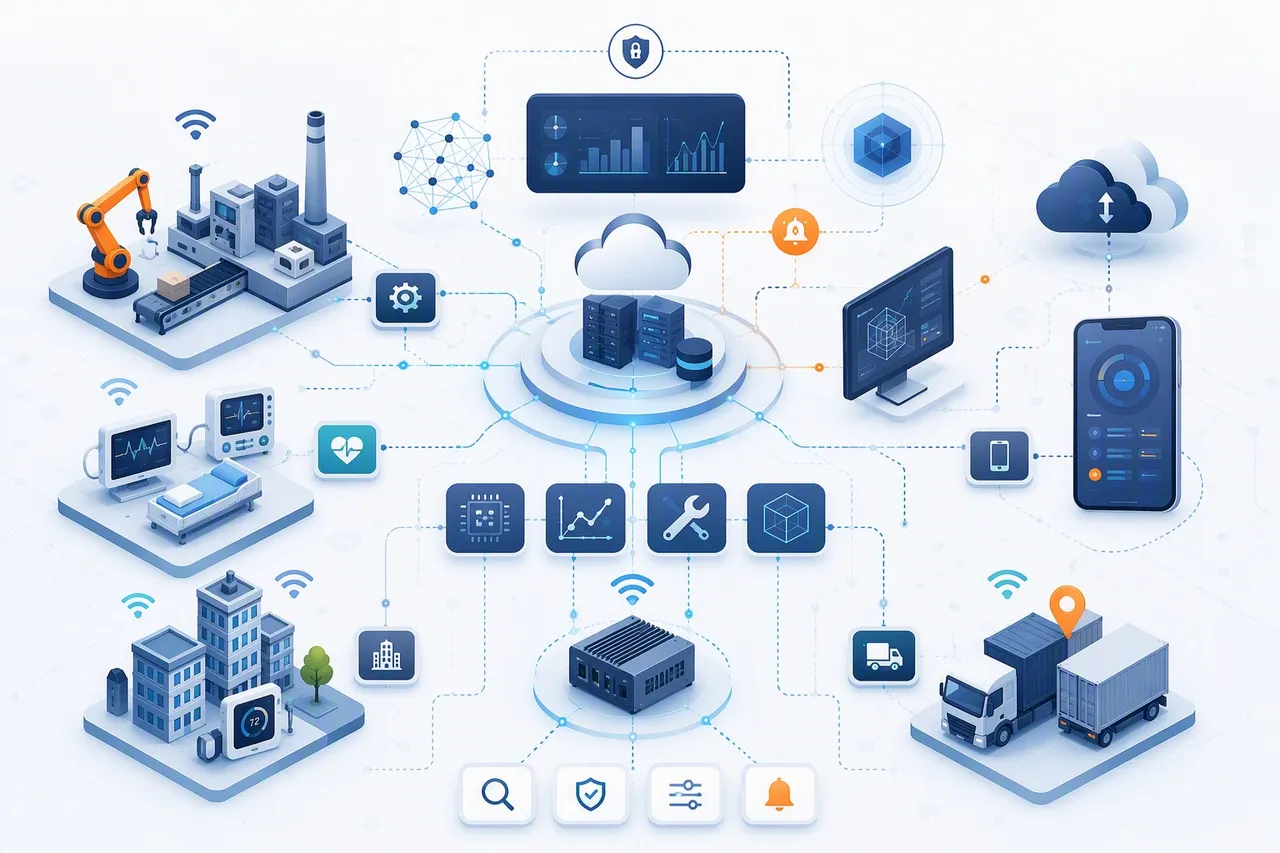
In 2026, modern IoT industry trends are shifting digital transformation from a software-only initiative into a connected operations strategy. This evolution of IoT in digital transformation bridges cloud-connected devices with physical infrastructure to create unified systems. Rather than relying on isolated applications, organizations use these IoT trends to improve visibility and operational resilience.
The strongest IoT initiatives require secure device management, reliable data pipelines, and a balanced mix of cloud and edge architecture. To deliver long-term value, teams must integrate real-time analytics with existing enterprise systems while maintaining clear operational goals. This approach helps decision-makers turn raw telemetry into actionable insights across distributed sites.
Key Takeaways
- Real-Time Automation: Modern IoT trends prioritize low-latency data processing to automate operational workflows.
- Edge Intelligence: Edge computing and localized AI process critical data on-site, reducing cloud dependency.
- Digital Twins: Industrial IoT deployments use connected virtual models to monitor physical assets.
- Device Governance: Robust cybersecurity and device lifecycle management are essential to protect connected networks.
- Integration Dependencies: Successful digital transformation relies on aligning IoT platforms with existing enterprise software.
IoT Industry Trends at a Glance
To navigate the evolving landscape, decision-makers must understand how key IoT trends function and their practical value.
| Trend | What It Means | Business Impact |
|---|---|---|
| Edge AI and Edge Computing | Localized data processing | Reduced latency and bandwidth |
| Industrial IoT and Predictive Maintenance | Sensor-based machine monitoring | Better maintenance planning and asset visibility |
| Digital Twins | Virtual asset modeling | Enhanced simulation and testing |
| IoT Cybersecurity and Device Governance | Device protection and control | Reduced vulnerability to threats |
| Cloud-Connected IoT Platforms | Centralized data integration | Unified operations and analytics |
| Connected Healthcare and Remote Monitoring | Remote patient observation | Better monitoring visibility and workflow coordination |
| Smart Buildings and Energy Management | Automated facility systems | Better energy usage visibility and facility automation |
| 5G Private Networks and eSIM | Flexible cellular connectivity | Simplified scaling and deployment |
Edge AI and Edge Computing
As a prominent driver of IoT digital transformation, many companies are moving data processing closer to physical devices to enable low-latency decisions and reduce bandwidth usage. According to AWS IoT official documentation, edge computing can support faster local processing when latency, bandwidth, or connectivity constraints make cloud-only processing less practical. This local processing allows industrial machinery, healthcare monitors, logistics trackers, and smart buildings to perform AI inference and diagnostics even during cloud connectivity disruptions.
While edge computing handles immediate, localized actions, cloud processing remains necessary for long-term data storage, complex model training, and large-scale orchestration. This balanced architecture is a key focus in modern IoT software development to optimize performance across diverse enterprise environments and ensure ongoing operational resilience.
Industrial IoT and Predictive Maintenance
Industrial IoT connects machinery, sensors, and production systems to monitor asset health in real time. By integrating these physical components, companies gain deep production visibility and can establish automated alerts for anomaly detection. This continuous equipment monitoring streamlines manufacturing operations, enhances quality control, and supports proactive business decision-making.
Predictive maintenance can help teams move from reactive repairs to more planned maintenance workflows, but results depend on data quality, equipment type, sensor reliability, and how well alerts are integrated into daily operations, which is why many manufacturers invest in purpose-built manufacturing software from the outset. For organizations seeking these operational efficiencies, custom manufacturing software development enables engineering teams to implement targeted downtime reduction strategies. However, key implementation risks include managing high volumes of data noise from legacy sensors and ensuring secure machine integration across the entire physical factory floor.
Digital Twins and Connected Asset Models
Digital twins serve as live virtual models of physical assets, systems, or environments, utilizing real-world data to optimize operations and support broader IoT digital transformation initiatives. According to Microsoft Azure Digital Twins documentation, these cloud-connected platforms create comprehensive twin graphs to enable asset simulation, remote monitoring, and operational planning across thousands of connected assets. In 2025, organizations increasingly applied these models to facility management, manufacturing, and smart city use cases to visualize complex physical relationships in real time. Successful deployment depends on integrating clean, structured data from IoT devices and business systems to ensure model accuracy, though teams must address implementation risks like data noise, security vulnerabilities, and the integration of legacy systems with modern IoT software development.
IoT Cybersecurity and Device Governance
Looking ahead, robust security must be built into the architecture from the start of any IoT software development project. According to the NIST IoT Device Cybersecurity Capability Core Baseline published in 2020, organizations need foundational capabilities to secure connected ecosystems. Effective device governance, a critical aspect of modern IoT technology trends, requires secure provisioning, unique device identity, and strict access control.
Teams must implement encrypted communication and continuous vulnerability monitoring to protect data in transit. Furthermore, managing the entire device lifecycle involves regular firmware and software updates, alongside comprehensive auditability and compliance tracking. Addressing these security requirements early helps mitigate implementation risks and safeguards IoT digital transformation initiatives against evolving threats.
Cloud-Connected IoT Platforms and Data Integration
IoT projects are more useful when device data is connected to the systems teams already use to manage operations, customers, assets, or workflows. To prevent these failures, modern cloud services enable secure cloud ingestion and event-driven architecture.
These integrations require robust APIs, real-time dashboards, and automated alerts to maintain data quality and clear ownership. Secure data storage and analytics are also essential to process telemetry before routing it to ERP, CRM, or MES platforms. When planning custom application development, teams must address implementation risks like data noise and legacy system compatibility. Aligning these elements is a key focus within current IoT industry trends, ensuring that connected devices actively support broader IoT digital transformation initiatives.
Connected Healthcare and Remote Monitoring
Currently, connected medical devices and remote patient monitoring systems are transforming care delivery by providing continuous visibility into patient-generated data. These IoT technology trends track vital signs and equipment status, allowing healthcare providers to optimize workflows and monitor critical assets remotely. Integrating these devices with existing healthcare platforms improves operational efficiency and coordinates care teams more effectively.
However, implementing connected healthcare solutions requires strict adherence to security and privacy regulations to protect sensitive patient information. Organizations must prioritize robust encryption and secure data transmission protocols to mitigate vulnerabilities while ensuring that telemetry integrates smoothly into electronic health records without disrupting clinical workflows.
Smart Buildings, Energy Management, and Sustainability
Currently, smart facilities leverage IoT digital transformation to optimize resource consumption, reduce waste, and streamline facility operations. According to AWS, connected sensors integrate HVAC, water, electricity, and solar systems to provide real-time energy usage visibility, which directly supports corporate sustainability reporting. Furthermore, occupancy monitoring platforms enable facilities managers to analyze space utilization, optimize desk pools, and automate HVAC and lighting controls based on actual daily demand. By combining asset monitoring with automated maintenance workflows, organizations can transition from reactive repairs to preventive maintenance, though engineering teams must address implementation risks like integrating legacy building management systems and securing diverse sensor networks.
Connectivity Trends: 5G, Private Networks, and eSIM
Modern IoT digital transformation relies on robust connectivity to support mobile IoT deployments and distributed devices. While 5G offers low latency, it is not required for every deployment. Instead, organizations are adopting private networks for industrial settings to secure local data, while eSIM technology simplifies global device management.
When planning IoT software development, teams must balance coverage, latency, and cost. Reliable connectivity is essential, but implementation risks include high cellular subscription costs and coverage gaps in remote areas. Evaluating these trade-offs helps decision-makers align their infrastructure with actual operational needs, ensuring stable data transmission without overpaying for unnecessary bandwidth. This pragmatic approach is shaping current IoT industry trends.
Scopic Demonstration: Connected Device Software in Practice
To illustrate how these IoT industry trends function in real-world scenarios, Scopic’s work on the TAP Kiln Control project demonstrates the integration of physical hardware and digital interfaces. This connected-device software simplifies complex thermal processes by enabling flexible schedule creation, live monitoring, and comprehensive firing history logging. By focusing on user-first UX design, the platform provides remote kiln control and mobile access. Furthermore, enhanced connectivity allows operators to manage multiple units simultaneously. This does not mean every IoT project needs the same architecture. It shows why connected-device software often requires device connectivity, real-time monitoring, data logging, user experience design, mobile access, and reliable control workflows to work in real operational environments.
Common IoT Implementation Challenges
While IoT offers significant potential for digital transformation, organizations today face complex deployment hurdles. Successfully scaling these connected initiatives requires addressing several common technical, operational, and strategic pitfalls:
- Unclear business use case
- Unreliable device connectivity
- Weak data quality
- Lack of integration with existing systems
- Poor device lifecycle management
- Security and access-control gaps
- Limited scalability planning
- No post-launch monitoring or support
- Choosing hardware before defining software requirements
- Underestimating user experience for operators or field teams
Addressing these challenges early in the planning phase helps development teams avoid costly project delays, secure their data pipelines, and ensure long-term operational viability across the entire ecosystem.
Practical Recommendation
The most valuable IoT projects usually start with a clear operational problem, not with a device-first idea. Before investing in IoT software, teams should define what needs to be monitored, what decisions the data should support, which systems must be integrated, and how devices will be secured and maintained after launch.
Scopic can help evaluate IoT product requirements, device connectivity, cloud architecture, mobile access, analytics, security needs, and long-term support before development begins.
Need help planning an IoT software project? Scopic can help assess your connected-device workflow, cloud architecture, data integration needs, security requirements, and product roadmap. Discuss your IoT software project with our professionals.
Conclusion
Moving forward, IoT industry trends continue to reshape digital transformation by focusing on practical business outcomes rather than technology for its own sake. Successful IoT software development requires aligning connected-device capabilities with real operational needs to deliver measurable value. For example, the TAP Kiln Control project demonstrates this balance by integrating connected-device software with schedule creation, live monitoring, firing history, enhanced connectivity, and mobile access for remote kiln control. This approach ensures that technical solutions directly support user efficiency.
Need help planning an IoT software project? Scopic can help assess your connected-device workflow, cloud architecture, data integration needs, security requirements, and product roadmap. Discuss your IoT software project with our team.
FAQ
What are the top IoT industry trends?
In the coming years, prominent IoT industry trends include the integration of edge AI for localized processing, the adoption of digital twins for asset visualization, and enhanced device governance. Additionally, organizations are focusing on robust IoT cybersecurity frameworks and hybrid cloud architectures to manage data pipelines effectively. These IoT trends help teams balance local performance with centralized data analysis.
How is IoT driving digital transformation?
IoT in digital transformation bridges the gap between physical operations and digital systems. By generating real-time telemetry, connected devices provide organizations with visibility into asset performance and workflows. This data integration allows teams to transition from reactive operations to structured, data-driven decision-making processes, improving overall operational resilience.
Which industries use IoT the most?
Industrial manufacturing, healthcare, logistics, and smart facility management are primary adopters of IoT technology trends. Manufacturers driving digital manufacturing initiatives use industrial IoT trends for predictive maintenance, while healthcare providers deploy remote monitoring systems. Logistics teams track assets across supply chains, and facility managers optimize energy consumption to support sustainability goals.
What is the role of edge computing in IoT?
Edge computing processes data closer to the physical device rather than relying solely on centralized cloud servers. This architecture reduces latency and bandwidth usage for immediate local actions. However, it is typically paired with cloud platforms for long-term storage and complex analytics, creating a balanced and resilient system.
How does AI work with IoT?
AI analyzes large volumes of telemetry generated by connected devices to identify patterns and anomalies. While IoT software development does not always require machine learning, combining these technologies helps automate complex workflows. This integration supports applications like predictive maintenance and automated quality control without requiring constant human intervention.
Why is IoT cybersecurity important?
Connected devices often expand the digital attack surface of an organization, making robust security essential. Implementing device governance, secure provisioning, and encrypted communication protects sensitive operational data. Following frameworks like the NIST baseline helps mitigate vulnerabilities across the entire device lifecycle, protecting both hardware and software.
What are common IoT implementation challenges?
Many projects face obstacles such as legacy system integration, poor data quality, and unreliable connectivity. Organizations also struggle with complex device lifecycle management and scaling security protocols. Addressing these challenges requires thorough planning, clear technical requirements, and structured post-launch support to ensure long-term reliability.
How do companies start an IoT digital transformation project?
Successful initiatives begin by identifying specific operational problems rather than adopting technology for its own sake. Teams should define which assets to monitor, plan how to integrate telemetry with existing ERP or CRM systems, and establish robust device security protocols before scaling their deployments to other areas.
This guide was written by Scopic Team
Scopic provides quality and informative content, powered by our deep-rooted expertise in software development. Our team of content writers and experts have great knowledge in the latest software technologies, allowing them to break down even the most complex topics in the field. They also know how to tackle topics from a wide range of industries, capture their essence, and deliver valuable content across all digital platforms.


 Message Scopio