
Table of Contents
“This article contains content that has been artificially generated or manipulated using AI tools.”
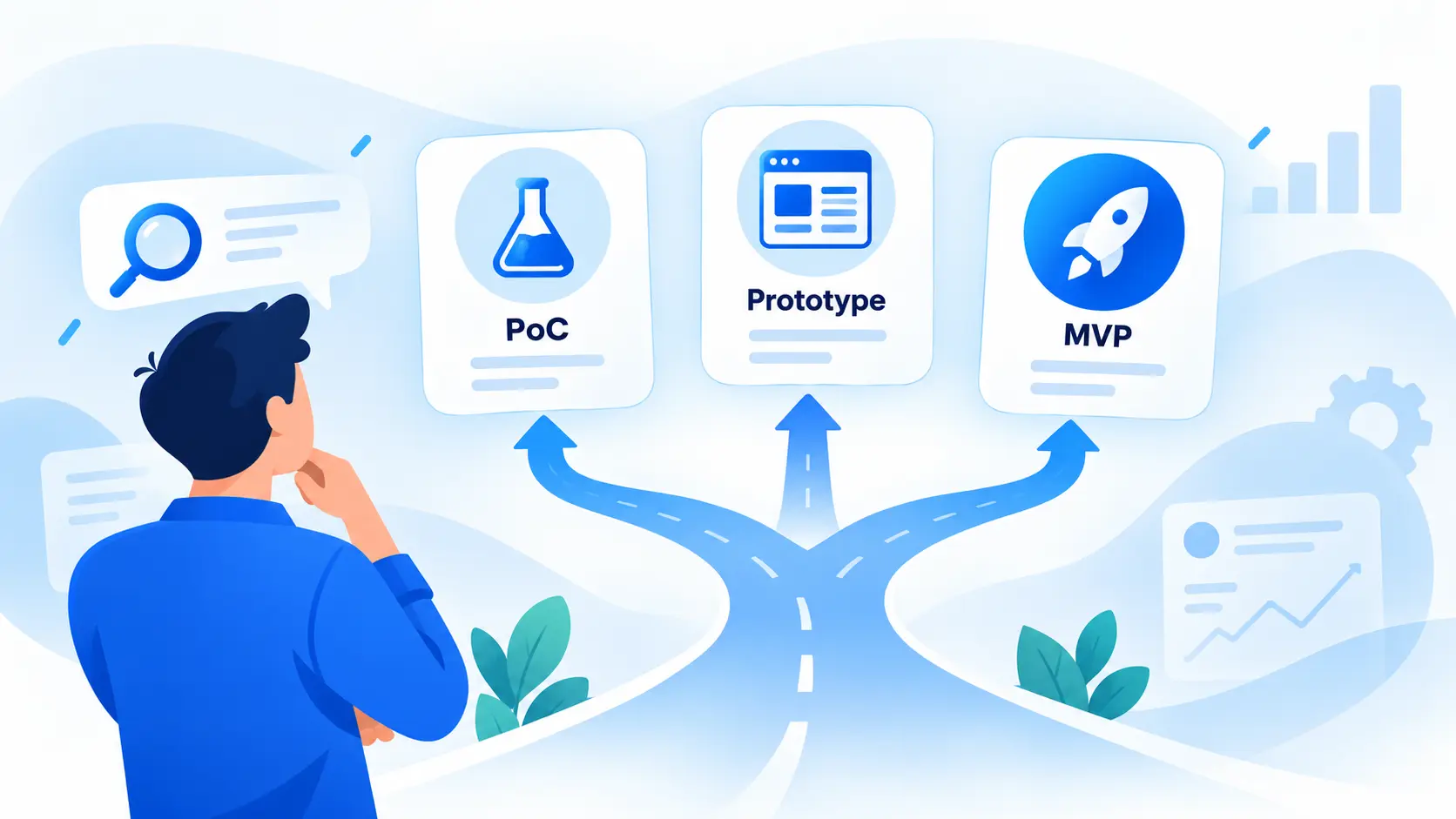
Comparing a proof of concept vs prototype is ultimately an investment decision: which uncertainty should you remove before committing more time and budget? A PoC tests whether a risky technical assumption is feasible, a prototype tests whether the concept and user flow make sense, and an MVP puts a working core product in front of real users to test value and demand.
These artifacts are not automatically sequential. Some products need all three, while others can skip one or more because the relevant question is already sufficiently answered. The decision matrix and decision tree below help you choose the smallest validation artifact that can address your largest unresolved risk.
Key Takeaways
- Choose your initial artifact based on your largest unresolved risk rather than following a rigid, predetermined sequence.
- Use a PoC for technical uncertainty, a prototype for concept or usability uncertainty, and an MVP when the remaining question requires real-world value or demand evidence.
- Establish explicit success criteria for each stage so the result produces decision-ready evidence for the next investment.
- Skip any validation stage if you already possess sufficient, high-confidence data answering that specific product question.
Proof of Concept vs Prototype vs MVP: The Decision Matrix
Evaluating a proof of concept vs prototype requires aligning risks with the right path. This matrix compares these validation artifacts across key dimensions. Choose your starting point based on what you must validate first.
| Decision Factor | Proof of Concept | Prototype | MVP |
|---|---|---|---|
| Question It Answers | Is the highest-risk technical approach feasible under the intended constraints? | Can stakeholders or prospective users understand and navigate the proposed experience? | Will real users use, value, or adopt a focused version that solves the target problem? |
| Primary Risk | Technical failure in a critical integration, algorithm, or workflow | Poor usability, unclear interactions, or a mismatch between the concept and user expectations | Low demand despite a functional product and its core features |
| Typical Deliverable | A narrow technical experiment or feasibility build that tests the riskiest assumption | An interactive wireframe or clickable flow that demonstrates the intended experience without full production logic | Working software with the minimum core features needed for real users to evaluate and adopt it |
| Functional Depth | Narrow scope with deep investigation of one feasibility question or technical constraint | Broad coverage of the main journey with shallow or simulated functionality | Focused implementation of the core features required to deliver the primary user outcome |
| Production Readiness | Usually not production-ready; built primarily to test the technical assumption | Usually not production-ready; intended primarily for concept, workflow, or usability validation | Sufficient for the intended early-user environment, but not necessarily feature-complete or scale-ready |
| Primary Audience | Internal developers and technical decision-makers who can assess feasibility evidence | Stakeholders and representative users who can assess flow, clarity, and usability | Early adopters who can use the product in a real context and signal whether demand exists |
| Evidence Produced | Technical feasibility evidence, including whether the critical approach works well enough to continue | User feedback on the proposed interaction, information flow, and perceived usability | Market-traction evidence from actual use, adoption behavior, and willingness to buy |
| Move Rorward When | The key technical risk is resolved and the approach is feasible enough to justify further validation | The core experience is understandable and major usability risks are sufficiently understood | Real-world usage and feedback provide enough evidence to justify iteration, expansion, or further investment |
| Fidelity | Only as complete as needed to test the technical assumption | Can range from low-fidelity sketches to highly interactive or selectively coded experiences | Functional enough for real users to experience the core value proposition |
Proof of Concept: Use It to Validate Technical Feasibility
According to the Atlassian PoC guide, a proof of concept (PoC) is a small-scale, internal demonstration used to gather evidence that a specific idea is technically feasible. When evaluating a proof of concept vs prototype, remember that a PoC targets a narrow technical uncertainty rather than the entire product. It is ideal for testing novel algorithms, unproven third-party integrations, unusual hardware constraints, or whether an LLM can process a niche proprietary data format. A PoC is often rough, narrow, and internal rather than production-ready; instead, it relies on predefined success criteria to support a clear go, revise, or stop decision before committing further capital.
Prototype: Use It to Validate the Concept and User Experience
A prototype helps determine whether users understand your concept and can navigate its core workflow. According to the Interaction Design Foundation, prototype fidelity ranges from low-fidelity sketches and clickable mockups to high-fidelity interactive designs or selectively coded demonstrations. Keep fidelity only as high as necessary to test the specific hypotheses that matter at this stage.
A prototype does not establish market demand, and even a polished mockup is not production-ready software. Before moving forward, document findings from user testing, for example, observed user feedback showing where target users can complete the core task successfully and where the workflow creates confusion or friction. Use those findings to identify usability issues and decide whether the concept or workflow needs refinement.
MVP: Use It to Validate Real-World Value and Demand
An MVP is the smallest functional, user-facing product that delivers your core value proposition and generates real-world learning. According to the Atlassian MVP guide, “minimum” refers to a limited scope of features rather than low quality. The product should work end to end for its primary use case, be usable by target customers, include instrumentation for learning, and meet appropriate security, reliability, and privacy baselines.
Unlike a proof of concept or prototype, which can establish technical feasibility or test a concept and user experience before broader release, an MVP puts the value proposition in customers’ hands. Focus on gathering market evidence rather than simply launching quickly. Before scaling, look for sustained engagement, continued use, or substantive qualitative feedback indicating that users receive meaningful value from the solution.
What Evidence Should Unlock the Next Investment?
Completing a development milestone should not automatically trigger progression to the next phase. Product owners can use the following comparison to determine whether the current artifact has produced objective, decision-ready proof for further funding. Capital allocation should follow verified technical feasibility, usability, or market-demand signals, not an arbitrary timeline.
| Current Stage | Evidence You Need | Next Decision |
|---|---|---|
| PoC | The critical technical assumption works under relevant constraints, major blockers are documented, and the architecture direction is plausible enough to justify further investment. | Stop, revise the technical approach, or move to the next relevant validation step based on the remaining risk. |
| Prototype | Representative users understand the core concept and workflow, and testing has identified the usability or interaction risks that still require refinement. | Refine the user experience when navigation or task completion remains unclear; build an MVP when the core workflow is understandable and the main open question is real-world demand. |
| MVP | Real usage and feedback indicate whether the core value proposition deserves more investment, using relevant signals such as repeat use, activation, customer interest, transactions, or willingness to pay where applicable. | Iterate, reposition, expand, scale, or stop based on the strength and repeatability of the evidence. |
When Can You Skip a PoC, Prototype, or MVP?
Deciding whether to build a proof of concept, prototype, or MVP, or move directly to a later stage, depends on which questions you have already answered with credible evidence. Skip a stage only when existing evidence addresses its purpose; do not skip one merely to reduce short-term cost. Use this comparison to assess your current validation status.
| Stage | You may be able to skip it when | Do not skip it when |
|---|---|---|
| PoC | The core technology uses standard, well-understood components, and the required integrations have already been proven in a comparable context. | The product depends on unproven algorithms, novel architecture, or technical assumptions that have not yet been tested with the intended integrations. |
| Prototype | The core workflow is already well understood or has been validated through prior research, an existing product, or comparable user behavior, and little meaningful interaction uncertainty remains. | The user journey is novel or materially different from existing solutions, so usability testing is needed to expose confusion, friction, or unmet interaction needs. |
| MVP | There is no external market-demand hypothesis to test, such as a bespoke internal system with committed users and well-defined requirements; a phased production build may be more appropriate. | You still need real-world evidence that customers will use the product, receive value from it, and remain engaged after adoption. |
Decision Tree: What Should You Build First?
Start with the most consequential unresolved risk, not with a mandatory sequence. If you still need evidence that the core technology can perform the required task, begin with a proof of concept. If technical feasibility is established but the intended user flow or workflow remains uncertain, test that experience with a prototype.
If feasibility and workflow are sufficiently understood but real-world demand remains unverified, prioritize an MVP. When several risks coexist, sequence experiments around the uncertainty that could make the next investment most wasteful. This risk-first approach lets you choose the appropriate starting point without requiring every product to pass through all three stages.
For teams comparing PoC vs Prototype vs MVP, the best answer is usually the artifact that resolves the costliest unknown before more budget is committed.
Common Sequencing Mistakes
Product teams often stumble during early-stage software development by making five critical sequencing errors.
- Treating PoC → prototype → MVP as mandatory. A fixed sequence can add work when one of those questions is already answered.
- Polishing a PoC like a customer-facing product. Extra UX or production work can distract from the technical feasibility question.
- Treating prototype feedback as proof of demand. Positive reactions to a concept or interface do not establish actual adoption.
- Shipping prototype-quality implementation as an MVP. A working demo may still lack the security, architecture, observability, testing, or data handling required for real users.
- Building an MVP before resolving a critical technical unknown. A risky integration, algorithm, hardware dependency, or performance constraint may deserve a focused feasibility test first.
From Product Uncertainty to the Right Validation Artifact
If the largest unresolved risk is still unclear, product discovery should come before implementation. Scopic’s product consulting process helps define the product vision, user needs, technical feasibility, architecture, priorities, and roadmap. Teams can then use rapid prototyping when the main uncertainty is the experience, or move into MVP development when the next meaningful question requires a working product in front of real users.
StreamerQue provides a practical MVP example. Scopic brought the platform’s core booking, availability, payment, and streamer-fan interaction workflows to market without waiting to build every possible feature. The MVP approach allowed the team to gather real-world feedback and guide later improvements from actual usage rather than assumptions. The example reflects the same principle used throughout this guide: invest in the artifact that produces the evidence needed for the next decision.
Conclusion
The right starting point depends on the uncertainty you need to resolve. Use a PoC for technical feasibility, a prototype for concept and usability questions, and an MVP when real-world value or demand is the remaining unknown. If the problem, audience, or product direction itself is still unclear, discovery may be the better first investment.
If you need help deciding what to validate before committing to development. Contact us to discuss your product idea and next investment decision.
FAQ
What is the difference between a proof of concept and a prototype?
A proof of concept primarily tests technical feasibility: whether a high-risk technical assumption, integration, or approach can work under relevant constraints. A prototype primarily tests the concept and user experience: whether people understand the proposed workflow and how they interact with it. Prototypes may range from simple wireframes to interactive or selectively coded experiences, so they are not limited to visual mockups.
Do you need a proof of concept before a prototype or MVP?
Not always. A PoC is useful when a meaningful technical uncertainty could affect whether or how the product should be built. If the technology, architecture, and integrations are already sufficiently understood, a team may start with a prototype or MVP depending on whether the remaining risk is usability or real-world value. Skip the PoC because its question is already answered, not simply to save time or budget.
Can you skip a prototype and go straight to an MVP?
Yes, when the core user experience is already sufficiently understood and prototype testing is unlikely to resolve a material uncertainty. This may apply to products with well-established workflows or experience patterns that have already been validated. If the interaction model is novel, complex, trust-sensitive, or poorly understood, prototype testing can still prevent expensive UX changes after development begins.
Can a prototype become an MVP?
Sometimes parts of a coded prototype can be reused, but a working or polished prototype should not automatically be treated as an MVP foundation. Before reusing prototype code, teams should assess architecture, security, data handling, testing, observability, maintainability, integrations, and the requirements of the intended real-user environment. In some projects reuse makes sense; in others, rebuilding the validated experience on a more appropriate production architecture is the better choice.
This article contains content that has been artificially generated or manipulated using AI tools. The article was reviewed and fact-checked by Srbuhi Avetisyan, AI Content Specialist at Scopic Software.
Scopic provides quality and informative content, powered by our deep-rooted expertise in software development. Our team of content writers and experts have great knowledge in the latest software technologies, allowing them to break down even the most complex topics in the field. They also know how to tackle topics from a wide range of industries, capture their essence, and deliver valuable content across all digital platforms.



 Message Scopio