
AccuSlice
AI-Powered 3D Bone Segmentation, Enhanced by a Vibe Coded Interface
The Challenge
Behind every accurate 3D bone model is a surprisingly complex workflow. Converting foot and ankle CT scans into precise 3D models has long required extensive manual effort. In traditional workflows, clinicians must manually segment each bone from CT scans before the models can be used for visualization or surgical planning.
And because the foot and ankle contain dozens of small, interconnected bones, even minor inaccuracies can affect the quality of the final model. Creating reliable 3D visualizations requires balancing precision with efficiency, making it difficult to produce results quickly enough for practical clinical use.
The challenge wasn’t just improving accuracy; it was finding a way to deliver reliable 3D models quickly enough to fit into real clinical workflows.
The Vision
The team behind AccuSlice recognized the opportunity to simplify one of the most time-consuming steps in orthopedic imaging. Their vision was to create an AI-powered platform that could automatically generate accurate 3D bone models from CT scans, helping clinicians spend less time on manual image processing and more time focused on patient care.
They also knew bringing that vision to life would require a development partner with deep expertise in AI, medical imaging, and vibe design to create an intuitive experience for clinicians, which led them to partner with Scopic.

The Scopic Solution
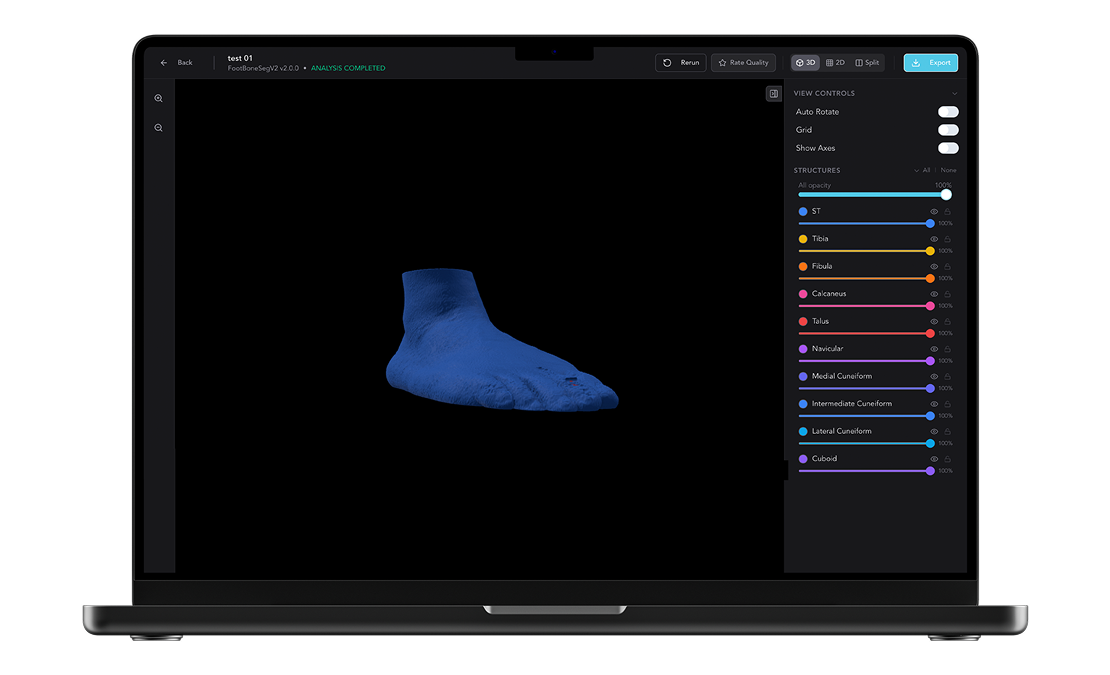
Scopic developed an AI-powered platform that transforms foot and ankle CT scans into accurate, labeled 3D bone models. The team built a solution that processes DICOM images, automatically segments individual bones, and generates STL files that clinicians can use for visualization and surgical planning.
Behind the scenes, Scopic also developed the data preparation and AI training pipeline needed to support accurate 3D bone segmentation. Leveraging advanced deep learning models capable of learning complex 3D bone structures, the team developed, trained, and validated the AI while continuously refining its performance to improve segmentation accuracy and reliability across a variety of CT scans with varying spacing and orientation.
Knowing that usability would be just as important as the AI itself, Scopic also developed an intuitive frontend in Replit. This vibe coded approach provided AccuSlice’s team with an efficient and user-friendly way to interact with the platform.
The resulting 3D models can be used to visualize fractures and deformities, assist with pre-surgical planning, and improve anatomical understanding for clinician training and patient communication.
Development is currently underway to expand the platform’s AI capabilities to additional body part CT scans.

Skills Involved:
AI & Machine LearningCustom Software DevelopmentUI/UX & Product DesignVibe CodingWeb Development
Other Projects



 Message Scopio