
Table of Contents
“This article contains content that has been artificially generated or manipulated using AI tools.”
Choosing among IT staff augmentation companies is less about finding the largest talent pool and more about understanding how each provider sources, vets, contracts, supports, and replaces the engineers who join your team. A software-services company supplying embedded employees operates differently from a curated freelance network or technology-driven talent platform, and those differences affect client control, continuity, onboarding, IP ownership, working-hour overlap, and commercial terms. This guide compares eight providers using those buyer criteria rather than review rankings or marketing claims. The companies are presented alphabetically, not ranked, and current provider facts are based primarily on official documentation rather than hands-on comparative testing by Scopic.
If you are still evaluating the model itself, see our software development staff augmentation guide for how staff augmentation works and when it fits.
Key Takeaways
- Talent model matters: provider-employed engineers, curated networks, and talent platforms create different accountability, continuity, and contracting structures.
- Evaluate the named engineer, not only the provider: verify seniority, working hours, technical fit, and interview results for the actual person joining the team.
- Separate matching from productive ramp: a provider may introduce candidates quickly while contracting, access setup, onboarding, and domain learning still take additional time.
- Contract terms matter as much as sourcing speed: replacement, IP assignment, security, notice periods, rate inclusions, and knowledge transfer should be clear before signing.
How We Evaluated the Companies
We selected eight providers with current public evidence of IT staff augmentation or embedded software-engineering talent. Companies appear alphabetically rather than as a ranking. We compared talent model, vetting, seniority, client control, ramp time, working-hour overlap, replacement, IP/security, technical specialization, and commercial transparency using first-party documentation as the primary evidence source. Scopic did not conduct hands-on comparative testing of competing providers.
Disclosure: Scopic publishes this article and is included because it publicly offers IT staff augmentation. It is assessed using the same criteria as the other providers.
Which Staff Augmentation Provider Model Fits Your Team?
| Provider Model | How It Works | Best Fit | Main Buyer Check |
| Software-services provider | Provider supplies engineers who embed in the client team | Teams wanting vendor accountability and ongoing support around placements | Who employs the engineer, availability, replacement, management boundaries |
| Curated talent network | Provider matches clients with vetted independent or network-based specialists | Teams prioritizing access to individual specialists | Contract status, continuity, trial/replacement, IP chain |
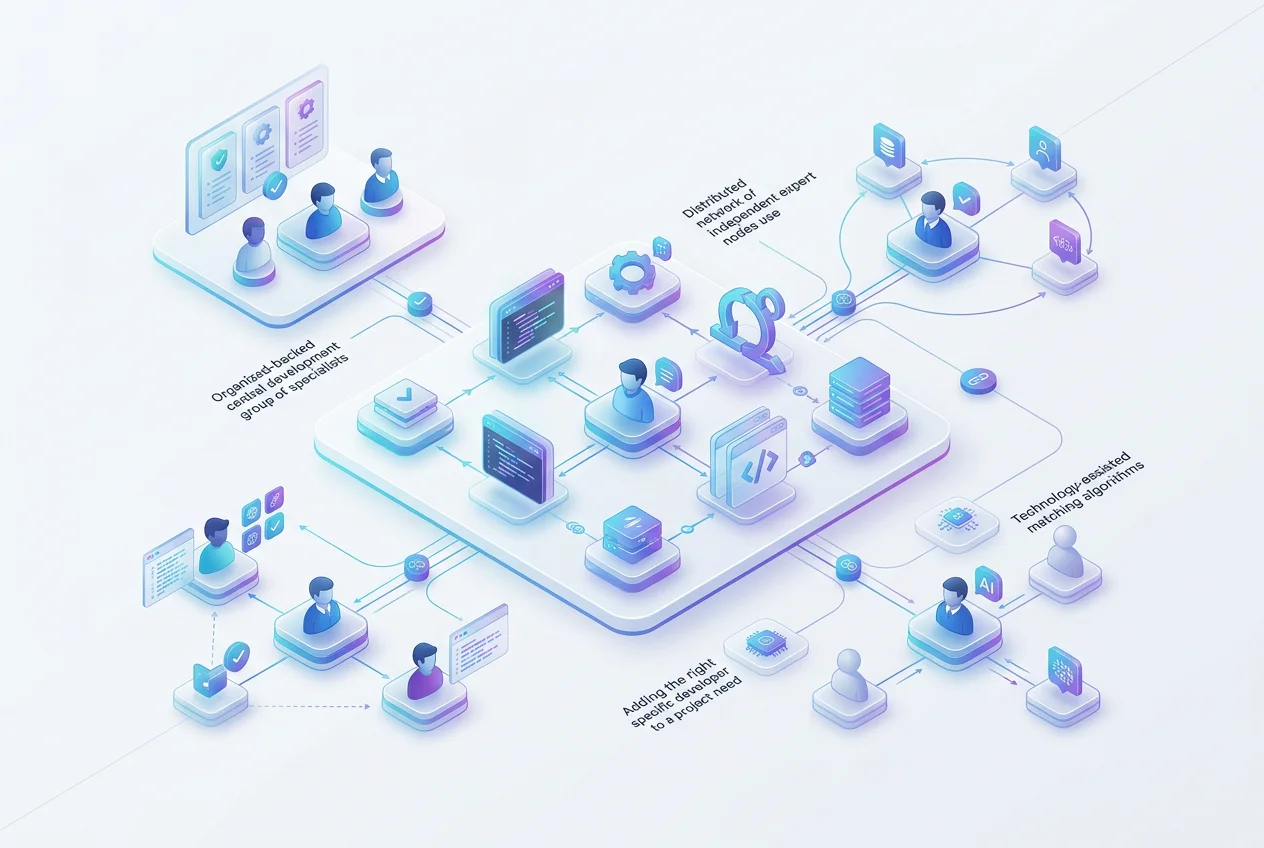
| Talent platform / hybrid network | Technology-assisted matching plus provider support | Teams wanting broad global sourcing with structured matching | Who manages performance, assessment transparency, rate structure, continuity |
None of these models is inherently better. The practical differences are who contracts or employs the engineer, how candidates are vetted, who manages performance, and what happens when availability or fit changes.
Complex portals are ultimately web applications, so buyers should also evaluate whether the development partner can handle backend architecture, integrations, deployment, and ongoing support. Scopic’s web application development services cover those surrounding capabilities.

Andela
Andela operates a global talent network that uses technology-assisted and human matching to connect companies with remote technologists.
Why it made the shortlist: Its public onboarding process includes English evaluation, technical assessment, live technical interviews, and client interviews before engagement.
Best for: Engineering teams seeking broad global access to individual software specialists.
Buyer check: Confirm how the named engineer is contracted, their working hours, availability/exclusivity, rate structure, replacement process, and who manages performance.

BairesDev
BairesDev supplies embedded engineers who work within client teams and follows a software-services provider model rather than an open talent marketplace.
Why it made the shortlist: Its current staff-augmentation material documents client-hour integration and a typical team setup window of roughly two to four weeks.
Best for: Teams adding several engineers and prioritizing substantial real-time collaboration with US-based staff.
Buyer check: Confirm named-engineer seniority, geography, client interview rights, replacement terms, minimum commitment, and whether the quoted timeline covers matching, onboarding, or productive ramp.

N-iX
N-iX provides enterprise team-extension services across Europe and the Americas with a structured sourcing and onboarding process.
Why it made the shortlist: Its current staff-augmentation page states that more than 90% of its experts are middle-plus or senior and cites approximately three to four weeks to fill a position.
Best for: Larger engineering organizations seeking structured augmentation and documented enterprise security practices.
Buyer check: Validate availability for the required role and geography, whether the published hiring timeline applies, replacement terms, commercial minimums, and project-specific security controls.

Scopic
Scopic provides IT staff augmentation through a globally distributed pool of software specialists who embed into client teams, with full-time and part-time options and time-zone matching.
Why it made the shortlist: Its public process combines technical interviews with Codeaid coding assessments designed around realistic development tasks.
Best for: Software teams needing embedded web, mobile, desktop, QA, design, or related technical specialists with flexible time-zone coverage.
Buyer check: Confirm the exact specialist’s availability, working-hour overlap, onboarding timeline, replacement terms, security requirements, and rate structure.
Scopic’s property-insurance web portal for Compass Adjusting demonstrates multi-user workflows, external communications integrations, authentication, location-based functionality, and ongoing product enhancement.

ScienceSoft
ScienceSoft provides IT staff augmentation across software development, QA, architecture, DevOps, and other technical roles using a software-services delivery model.
Why it made the shortlist: Its current service materials describe hourly staff augmentation, broad role coverage, and both short- and long-term engagement options.
Best for: Enterprise teams that value a broader engineering organization and structured contracting around augmented specialists.
Buyer check: Confirm named-candidate seniority, location and working hours, replacement/notice terms, project-specific security requirements, and the current hourly quotation.

Toptal
Toptal is a curated freelance talent network that matches companies with individual software engineering specialists.
Why it made the shortlist: Current Toptal documentation provides a trial period of up to two weeks and a documented rematching path when a placement is not satisfactory.
Best for: Teams seeking one or a small number of specialized individual contributors.
Buyer check: Confirm the specific expert’s rate, working hours, availability/exclusivity, contract status, trial conditions, IP terms, and long-term continuity.

Turing
Turing has publicly positioned its Talent Cloud as a technology-driven model for sourcing and matching remote software engineers.
Why it made the shortlist: Its model represents the technology-assisted talent-platform category in this comparison.
Best for: Teams evaluating globally sourced specialists through an algorithmically assisted matching process.
Buyer check: Before shortlisting Turing in 2026, confirm its current staff-augmentation offering, candidate-management model, contract structure, matching/onboarding timeline, and replacement terms directly from current official sales documentation.

X-Team
X-Team provides pre-vetted engineers who embed into client tools, standups, and sprint cadence, supported by the provider’s global remote engineering community.
Why it made the shortlist: Its current staff-augmentation documentation covers client interviews, provider-handled employment logistics, monthly engineer-based pricing, and replacement support.
Best for: Engineering organizations seeking longer-term embedded senior engineers rather than short-term freelance tasks.
Buyer check: Confirm engineer location and working hours, ramp timing, monthly rate, minimum engagement, replacement terms, and employment structure.
What Software Teams Should Compare Before Choosing a Provider
To avoid integration friction, engineering leaders should evaluate providers across operational and legal dimensions, including security documentation, collaboration coverage, staffing controls, and commercial terms. Whether you are reviewing staff augmentation companies or a narrower staff augmentation agency shortlist, the table below outlines procurement criteria and the checks buyers should complete before deciding.
| Decision Area | What to Verify |
|---|---|
| Talent Model | Employee, contractor, freelancer, or network member; who owns HR/performance support |
| Vetting & seniority | Technical assessment, live interview, communication evaluation, and whether you can interview the exact engineer |
| Client control | Whether the engineer joins your tools, backlog, standups, reviews, and reports to your technical leadership |
| Control | Confirm whether the buyer can interview candidates, approve replacements, shape team composition, and integrate developers into its own engineering processes. |
| Ramp & Working hours | Candidate-match time vs signed start vs productive ramp; actual working-hour overlap |
| Replacement & continuity | Replacement triggers, notice, transition time, knowledge transfer, and what happens if the engineer leaves |
| Commercials | Hourly/monthly rate, minimum term, overtime, rate changes, provider fees, and conversion terms where applicable |
IT Staff Augmentation Companies at a Glance
Engineering leaders can use this matrix to compare operational structures, delivery signals, and likely engagement fit. It outlines how each provider supplies talent and where that model may be most useful. Procurement teams should use the buyer checks to verify integration, availability, compliance, and commercial requirements before selection.
| Company | Talent Model | Best Fit | Main Buyer Check |
|---|---|---|---|
| Andela | Global curated talent network | Broad access to individual specialists | Contract status, timezone, continuity, rate |
| BairesDev | Software-services provider | Scaling embedded engineering capacity | Seniority, start timing, replacement, terms |
| N-iX | Enterprise team-extension provider | Structured enterprise augmentation | Availability, geography, ramp, security |
| Scopic | Global software-services provider | Multi-disciplinary embedded specialists | Availability, overlap, replacement, pricing |
| ScienceSoft | IT services / provider-supplied specialists | Enterprise and regulated environments | Named seniority, timezone, contract terms |
| Toptal | Curated freelance network | Individual specialized contributors | Trial terms, rate, availability, IP |
| Turing | Technology-driven talent platform | Global developer sourcing | Verify current model, terms, and continuity |
| X-Team | Provider-supported engineer community | Long-term embedded engineers | Ramp, working hours, monthly rate, replacement |
Questions to Ask Before Signing a Staff Augmentation Contract
Before finalizing an agreement, engineering leaders should clarify the operational, commercial, and legal terms that determine whether the proposed engineer can work effectively within the team. Use this checklist to evaluate candidate alignment, verify responsibilities, and surface risks before commitment. This is especially useful when comparing staff augmentation providers with different hiring, support, and replacement models. Always request the named engineer’s profile and a sample contract before signing.
| Question | Focus Area |
|---|---|
| Who employs the engineer, and who is responsible for payroll, taxes, benefits, and employment obligations? | Confirm the employer of record, day-to-day management responsibilities, and liabilities that remain with the provider or client. |
| Can we interview the exact person who will join the team, and what vetting evidence is available? | Assess technical fit, communication style, relevant experience, and whether the proposed engineer, not a substitute, has been evaluated. |
| What is the expected timeline from approval to start date and productive ramp? | Confirm sourcing steps, availability, onboarding dependencies, and when the engineer should be able to contribute independently. |
| What working hours, time-zone overlap, and scheduling expectations apply? | Check collaboration coverage, meeting availability, responsiveness, holidays, and alignment with the client team’s operating hours. |
| How are replacements handled if the engineer leaves, underperforms, or becomes unavailable? | Clarify notice periods, replacement qualifications, handoff obligations, knowledge-transfer process, and continuity protections. |
| Who owns the intellectual property created during the engagement, and how is it assigned? | Verify ownership of code, documentation, inventions, and other deliverables, including assignment language and any provider or engineer rights. |
| What do the rates include, and which additional fees or commitments may apply? | Request an itemized view of compensation, provider fees, onboarding, overtime, termination, replacement, and other potentially chargeable services. |
Ask these questions for the named engineer and actual contract, not only at company level.
How to Build a Shortlist
Start by defining the exact gap: role, technology, seniority, start date, weekly hours, and expected duration. Then decide whether you are comfortable with a provider-employed specialist, an independent/network professional, or a talent-platform model. Set non-negotiables for working hours, security, employment structure, and technical experience before interviewing named candidates. Compare contracts on equivalent terms, including rate, minimum commitment, replacement, overtime, notice, and any conversion fee. Where practical, begin with one or a small number of roles and scale only after the engineers integrate successfully. Define offboarding, documentation, repository access, and knowledge transfer before the engagement begins.
Conclusion
Choosing an IT staff augmentation provider should start with the operating model your engineering team can support. Software-services providers can offer more centralized vendor accountability, while curated talent networks and platforms can broaden access to individual specialists. In either model, evaluate the exact engineer rather than relying on company reputation alone. Vetting, seniority, working hours, client control, replacement terms, IP/security, technical fit, and commercial structure ultimately determine whether the engagement works. Start with the capacity you actually need, then scale only after the collaboration proves effective.
If you need vetted software specialists to extend your development team. Contact us to discuss your requirements.
FAQ
Which is the best IT staff augmentation company in 2026?
There is no universal best provider. Andela, BairesDev, N-iX, Scopic, ScienceSoft, Toptal, Turing, and X-Team represent different combinations of software-services providers, talent networks, and technology-driven matching platforms. The right shortlist depends on the role and seniority required, working-hour overlap, client control, replacement and continuity expectations, IP/security requirements, and commercial terms.
How should engineering leaders choose between different staff augmentation providers?
Compare the provider’s talent model, vetting process, seniority evidence, client interview rights, expected ramp, actual working hours, replacement policy, IP/security terms, technical specialization, and contract structure. Most importantly, evaluate the specific engineer who will join your team rather than relying only on company-level credentials.
What is the difference between an IT staff augmentation company and a freelance marketplace?
Neither model is universally better. A software-services provider may employ or support engineers directly and provide more centralized continuity and vendor accountability. A curated talent network may offer broader or faster access to individual specialists. Compare who contracts the engineer, how vetting works, who manages performance, replacement terms, availability, IP assignment, and total cost for the specific engagement.
How quickly can staff augmentation providers add developers to an existing team?
There is no universal timeline. Some providers publish candidate or team-matching targets ranging from days to several weeks, but matching is not the same as productive onboarding. Ask separately about candidate introduction, client interviews, contracting, security/access setup, start date, and the time needed for the engineer to contribute independently. Verify the timeline for your exact role and technology rather than relying on a company-wide headline.
This article contains content that has been artificially generated or manipulated using AI tools. The article was reviewed and fact-checked by Srbuhi Avetisyan, AI Content Specialist at Scopic Software.
Scopic provides quality and informative content, powered by our deep-rooted expertise in software development. Our team of content writers and experts have great knowledge in the latest software technologies, allowing them to break down even the most complex topics in the field. They also know how to tackle topics from a wide range of industries, capture their essence, and deliver valuable content across all digital platforms.




 Message Scopio