
Table of Contents
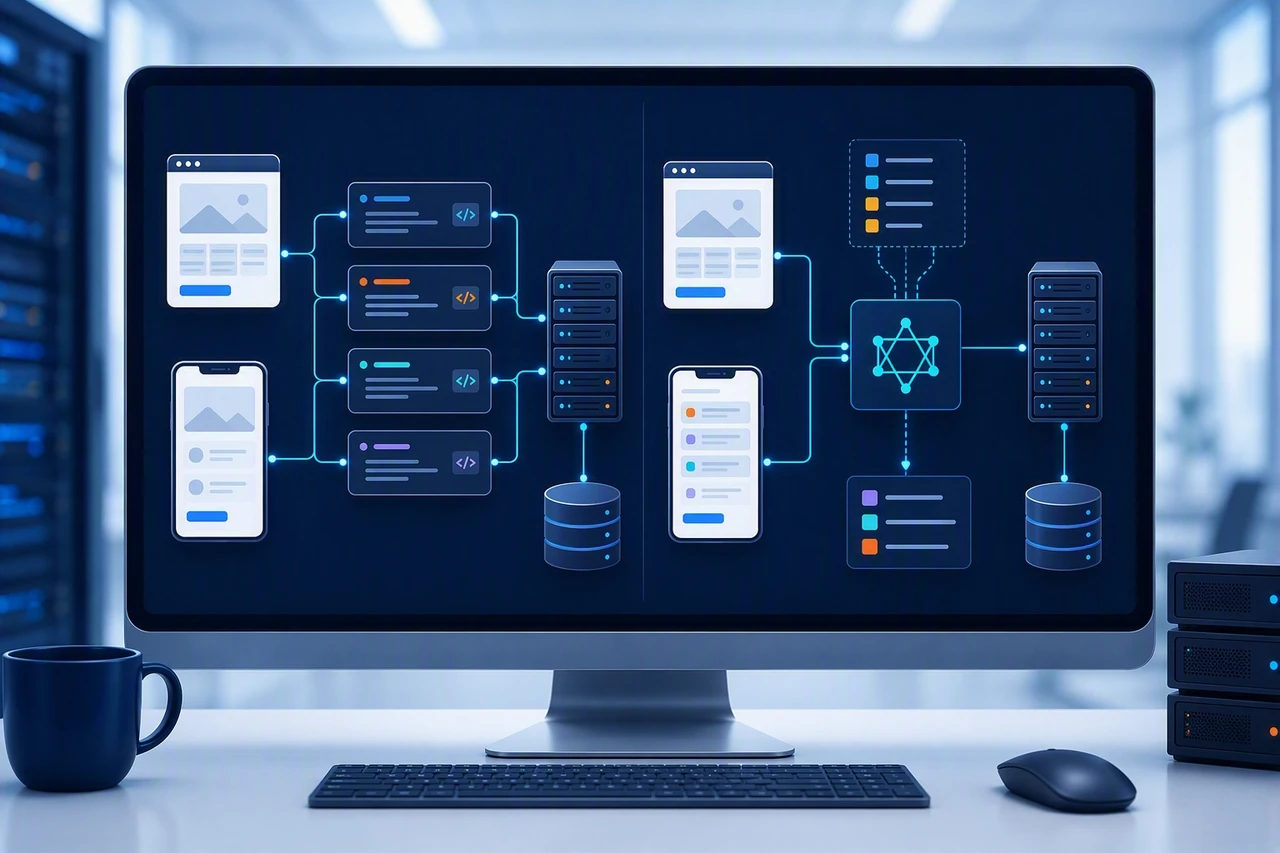
Choosing between GraphQL and REST is not a contest between a modern and an outdated API style. It is an architectural decision about who controls response shapes, how clients compose data, how caching works, and how much governance the platform team can support. REST organizes an API around resources and HTTP semantics, while GraphQL exposes a typed schema through which clients select the fields and relationships they need.
GraphQL can reduce client-side over-fetching, under-fetching, and request coordination for products with varied web and mobile views. REST often makes HTTP caching, status handling, and third-party integration more straightforward. This GraphQL vs REST API comparison examines data fetching, caching, schema evolution, real-time delivery, errors, tooling, performance, security, and migration so you can choose based on real workloads and operating constraints.
Key Takeaways
- REST exposes resource representations through endpoint contracts, while GraphQL lets clients query a typed schema. Both support client-server data exchange, but they shape requests and responses differently.
- GraphQL can reduce over-fetching and under-fetching for varied clients, while REST usually fits HTTP caching, ETags, and CDN delivery more directly.
- REST commonly manages breaking changes through URI or header versions; GraphQL generally evolves its schema through additions, deprecations, and coordinated client updates.
- GraphQL requires query-complexity controls, resolver planning, and specialized tooling, including safeguards for deep queries and N+1 behavior.
- Teams serving mixed clients often combine both: a gateway or BFF can expose GraphQL over existing REST services instead of requiring a full rewrite.
What Is REST? What Is GraphQL? Core Architectural Models
According to Fielding’s dissertation, REST is an architectural style for distributed systems built on resource identification, a uniform interface, and stateless communication. A REST API typically exposes resources through endpoint representations, with each request containing the information needed for processing.
GraphQL is a query language for APIs and a server-side runtime built around a strongly typed schema. When GraphQL is served over HTTP, a service normally exposes a single endpoint, often /graphql, and clients submit queries and mutations defined by that schema. Resolvers and the underlying business logic retrieve or change data in databases and downstream services.
Both approaches support client-server data exchange but organize it differently. REST centers interactions on resources and standardized interface semantics, whereas GraphQL centers them on a typed data graph and client-defined selection sets. Both can sit in front of the same backend data, databases, or existing services. This distinction matters when evaluating broader custom application development architecture because the API model can change client composition without requiring a different data layer.
GraphQL vs REST: Key Differences
Use this table to compare structural behavior and operational consequences for a new service or a mixed-client platform. In a REST API vs GraphQL comparison, validate cache policy, query governance, client autonomy, and observability against the expected workload before choosing.
| Criterion | REST | GraphQL | Decision implication |
|---|---|---|---|
| Endpoint/resource model | Resource-oriented URLs and representations | Usually one HTTP endpoint backed by a typed schema | Choose based on resource boundaries and client composition needs |
| Data fetching | Fixed shapes can over-fetch or under-fetch | Clients select fields and relationships | GraphQL helps varied clients, subject to query controls |
| Caching | Native HTTP, ETags, Cache-Control, CDNs | HTTP caching is available for GET queries and persisted documents; normalized client caching is also common |
REST often makes shared CDN caching simpler; both approaches require explicit cache and invalidation policies |
| Schema and typing | Optional OpenAPI or similar contract | Built-in typed schema and introspection |
GraphQL provides a machine-readable contract, but governance remains a team responsibility |
| Versioning approach | URI, header, or media-type versions | Prefer additive evolution and deprecation | Assess change discipline and consumer coordination |
| Real-time support | Polling, webhooks, or separate WebSockets | Subscriptions through supporting infrastructure | Match event latency and connection requirements |
| Error handling | HTTP status codes communicate outcomes | The response body can contain data, errors, or both; partial data normally uses a 2xx HTTP status | Align monitoring and client retry semantics |
| Tooling maturity | Broad, mature HTTP and gateway tooling | Strong client tooling, added server governance | Compare team skills and platform integration |
| Performance profile | Predictable requests, repeated round trips possible | Can reduce client round trips, but resolver fan-out, deep queries, and N+1 patterns can increase server cost | Load-test representative client operations |
| Security surface | Object- and operation-level authorization, route controls, and input validation | Object- and field-level authorization in business logic, plus query depth and cost controls | Threat-model authorization and resource-exhaustion risks for the chosen interface |
| Learning curve/complexity | Familiar resource conventions | Flexible, but requires schema and resolver discipline | Choose complexity your team can operate reliably |
Over-Fetching, Under-Fetching, and Data Shaping
REST endpoints commonly expose fixed, server-defined response shapes. A web or mobile client may receive fields it does not use, which is over-fetching. If one representation omits related resources, the client may under-fetch and issue additional requests to other URLs. For a screen combining account, orders, and recommendations, this can create several round trips and more client-side composition.
GraphQL lets each client specify the fields and nested relationships it requires. From the client’s perspective, this can consolidate several fetches into one network request without requiring a separate endpoint variant for every screen or device.
That consolidation does not guarantee a single database query or downstream-service call. One GraphQL request can still trigger N+1 access patterns, expensive joins, or extensive service fan-out. Teams therefore need batching, request-scoped caching, pagination, query limits, and operation-level observability to preserve client flexibility without creating unpredictable backend cost.
Caching and CDN Behavior
REST usually aligns with HTTP caching because each resource representation has a distinct URL. A response can declare freshness and sharing rules with Cache-Control, while ETag enables conditional requests and 304 Not Modified responses. CDNs can therefore cache public, URL-addressable responses at the edge, subject to authorization, invalidation, and cache-key design. MDN’s HTTP caching guidance describes this URL-based model and its use of managed caches.
GraphQL can also use standard HTTP caching for query operations sent with GET. Persisted documents can replace long query strings with short identifiers, making cache keys more practical at gateways and CDNs. POST-based requests and personalized responses, however, normally require explicit cache configuration. The current GraphQL-over-HTTP guidance explains how GET queries and persisted documents can support HTTP and edge caching.
Normalized client caches solve a different problem: they reuse objects inside the application but do not replace shared gateway or CDN caching. REST is usually the simpler default when public, URL-addressable representations must be cached broadly at the edge. GraphQL may justify the additional cache-policy and invalidation work when client-specific data shaping is more important.
Schema, Typing, and API Versioning
GraphQL’s schema defines the available operations and data model. According to GraphQL.org’s schema documentation, its type system models objects, scalars, enums, interfaces, unions, and input objects. GraphQL introspection lets clients and tools discover supported types, fields, and documentation, enabling validation and generated clients when exposure is governed carefully.
REST does not require an equivalent schema layer. Teams can publish an OpenAPI Specification to describe request and response shapes, validation, and documentation, but keeping that document aligned with deployed endpoints remains a governance and delivery-pipeline responsibility. Versioning is therefore commonly explicit in a URI or header, such as /v1/ and /v2/, allowing clients to select a contract.
GraphQL typically evolves one schema by adding fields and marking older ones with @deprecated, rather than versioning the entire API. That limits parallel endpoint management, but requires usage monitoring, deprecation policy, and disciplined removal. REST can evolve compatibly too, although major contract changes are often isolated through URI or media-type versions. In rest api vs graphql planning, this versioning difference often shapes migration effort and client coordination.
Real-Time Data: Subscriptions vs. Polling and Webhooks
GraphQL subscriptions are a spec-defined operation type for event-driven updates. According to GraphQL.org, GraphQL does not mandate a transport, but implementations typically use WebSockets or Server-Sent Events (SSE) to keep a long-lived connection and push data that matches the client’s requested selection set. This can reduce refresh latency and avoid repeatedly fetching unchanged state, but it introduces connection lifecycle, fan-out, backpressure, and reconnect concerns.
REST has no native subscription operation or standard push mechanism. A REST client commonly polls an endpoint, uses long-polling, or receives events through a separate webhook or WebSocket integration. Polling is operationally straightforward for slowly changing data, while frequent polling can create unnecessary traffic and stale windows. Webhooks shift delivery responsibility to the server and require endpoint authentication, retries, signature validation, and idempotent processing.
Choose subscriptions when interactive clients need low-latency, selective updates and the team can operate stateful connections. Prefer polling for modest freshness requirements or simple deployments, and webhooks for server-to-server notifications where consumers can acknowledge and retry deliveries. In either model, define authorization at subscription or event scope, reconnect behavior, ordering expectations, and replay or recovery semantics.
Error Handling and Status Codes
REST commonly communicates request outcomes through HTTP status codes. According to RFC 9110, 2xx indicate success, 4xx client errors, and 5xx server errors; the body can add diagnostic and remediation context. This transport-level signal works naturally with clients, gateways, monitoring, and generic HTTP tooling, provided teams standardize error schemas.
GraphQL separates transport outcomes from operation results. A response can contain data, errors, or both. Under current GraphQL-over-HTTP guidance, a response containing non-null data should use a 2xx status, even when field errors produce a partial result. Errors that prevent execution may use a 4xx or 5xx status depending on the failure stage, implementation, and response media type.
REST provides more conventional HTTP-native outcome signaling, while GraphQL provides structured application-level errors and can return partial data. GraphQL clients and monitoring systems should therefore inspect both the HTTP status and the response body. Teams should also standardize application error codes, retry rules, logging, and client behavior instead of treating every GraphQL response as successful merely because it returned HTTP 200.
Tooling, Developer Experience, and Ecosystem
REST benefits from mature tooling built over two decades: Postman supports authentication, scripts, mocks, CI workflows, and client snippets, while OpenAPI with Swagger UI supports contract documentation, testing, and generated clients. API gateways add established policy, routing, and observability integrations. This breadth can reduce friction when partners already use conventional HTTP workflows.
GraphQL tooling is schema-driven. GraphiQL offers an interactive IDE with type-ahead and validation; Apollo Client supports cache inspection, and Apollo GraphOS provides schema checks and operation-level observability. Schema-based code generation can produce typed client models and operation helpers, reducing hand-maintained contract code, but introduces concepts such as resolvers, fragments, and query controls.
For teams new to GraphQL, the initial learning curve is steeper, particularly around schema governance and query observability. REST fits better when existing gateway, testing, and partner tooling dominates; GraphQL can fit when multiple clients need flexible, typed data access. This is one area where rest vs graphql decisions depend as much on team operations as on response shape.
Performance, Query Complexity, and Security
A GraphQL operation can create an N+1 pattern when one resolver loads a collection and additional resolvers independently load related data for each item. DataLoader-style batching and request-scoped memoization can reduce duplicate calls, but they do not fix inefficient joins, unbounded fan-out, or slow downstream services.
Because public GraphQL APIs can accept many valid query shapes, teams should control resource consumption with trusted or persisted documents where appropriate, depth and breadth limits, query-cost analysis, pagination caps, timeouts, rate limits, and request-size limits. Authorization should be implemented in reusable business logic called during execution, with object- and field-level checks where the domain requires them.
REST can make coarse traffic controls easier to map to routes and HTTP methods, while GraphQL can apply controls by operation, field, or calculated query cost. Neither model is inherently secure or predictable. Both require authentication, object-level authorization, input validation, rate limiting, abuse detection, observability, and representative load testing.
Whichever model you choose, apply consistent software development best practices to contract review, automated testing, secure configuration, observability, and change management.
Mobile and Multi-Client API Design
For a product serving web, mobile, and partner clients, GraphQL can expose one governed schema while allowing each client to request the data shape it needs. A bandwidth-constrained mobile release can request a compact response, while web clients compose richer views without a separate endpoint for every screen.
REST can support the same clients, but teams may choose client-side composition, purpose-built aggregate endpoints, or a backend-for-frontend (BFF) when different interfaces require substantially different data shapes. A BFF tailors payloads and shields mobile clients from service boundaries; separate versions preserve partner contracts when release schedules differ. These options add deployment, monitoring, and contract-governance surfaces.
Choose GraphQL for a multi-client product when teams need autonomy and requirements change frequently, then validate resolver performance, query limits, field and object authorization, and caching. Choose REST with BFFs when HTTP caching, operational isolation, or partner familiarity outweigh schema flexibility, and validate endpoint ownership, version retirement, and aggregate latency. A hybrid may suit stable partner resources in REST with GraphQL for application-facing composition, provided the boundary and duplicated logic are monitored.
Migration and Hybrid Strategies: Can You Use Both?
Adopting GraphQL rarely requires a full rewrite. A GraphQL gateway or backend-for-frontend (BFF) can expose a client-oriented schema while calling existing REST services as data sources. According to Apollo Server’s guidance, RESTDataSource supports this composition pattern, allowing resolvers to reuse HTTP APIs during migration.
Teams can migrate clients incrementally: introduce GraphQL for a mobile or web surface, retain REST for established consumers, and move capabilities behind the gateway as contracts stabilize. Azure’s BFF pattern describes an additional layer for interface-specific requirements, implemented with GraphQL or other service logic, without rewriting underlying microservices.
Running both long term can be sensible when partner integrations need resource-oriented endpoints, while product clients benefit from composed queries. Treat the gateway as a protocol and policy boundary: define ownership, map authentication and authorization consistently, document error translation, and monitor resolver-to-service calls. This avoids forcing every team or consumer onto one contract, but adds schema governance, operational paths, and testing for two API surfaces.
Hybrid architectures also introduce integration work behind the gateway, including authentication mapping, data transformation, retry behavior, error translation, monitoring, and ongoing maintenance. Scopic’s API integration cost guide explains how these requirements affect implementation scope and long-term investment.
Which Should You Choose? A Decision Table by Use Case
Use this table to compare client control, delivery patterns, caching requirements, and operational governance. Treat each default as a starting hypothesis, then validate contract stability, query behavior, observability, and the team’s ability to operate the selected approach.
| Use Case | Better default fit | Why | Watch-outs |
|---|---|---|---|
| Public API for third-party developers | REST, when broad tooling and predictable contracts matter | Resource-oriented endpoints, standard HTTP semantics, and OpenAPI are familiar to diverse consumers. | Validate long-term versioning, documentation, quotas, and backward compatibility. |
| Multi-client product (web + mobile + partner) | GraphQL, when clients need different views of shared data | A shared schema can reduce client-specific aggregation and support evolving selections. | Validate query governance, partner expectations, caching, and authorization by field. |
| Internal microservice-to-microservice calls | REST, when bounded operations and infrastructure controls dominate | Explicit resources and status codes can simplify service ownership and traffic policy. | Validate whether events, RPC, or existing service contracts fit better. |
| Content-heavy site needing CDN caching | REST, when cacheable representations are central | Distinct URLs align naturally with CDN and HTTP cache keys. | Validate invalidation, personalization, and freshness requirements. |
| Real-time/collaborative app | GraphQL, when clients need selective live updates | Subscriptions can align pushed data with each client’s selected fields. | Validate connection scale, delivery guarantees, conflict handling, and fallback behavior. |
| Small team/simple CRUD service | REST, when scope and response shapes are stable | Conventional endpoints can minimize moving parts and operational overhead. | Validate future client variance, schema tooling, and migration boundaries. |
Conclusion
REST is usually the stronger default when an API centers on stable resources, conventional HTTP behavior, shared CDN caching, or broad third-party consumption. GraphQL becomes more compelling when several product clients need different views of shared data, requirements change frequently, or client-side composition has become difficult. Neither approach is inherently faster, safer, or easier to maintain; those outcomes depend on schema and endpoint design, authorization, caching, observability, and operational discipline.
A hybrid architecture can also preserve stable REST integrations while introducing GraphQL for client-facing composition. Scopic’s engineering teams design and integrate both REST and GraphQL APIs as part of custom software projects. If you are selecting an API architecture or modernizing an existing integration layer, contact Scopic to evaluate the options against your product, client mix, security requirements, and expected workloads.
FAQ
Is GraphQL better than REST?
GraphQL can be a better fit when several clients need different fields, relationships, or release cadences from the same domain model. Its schema and query model can reduce client-specific endpoints, but they also require governance for query depth, resolver behavior, authorization, and observability. REST can be preferable when resource-oriented contracts, HTTP caching, straightforward traffic controls, or broad partner familiarity matter more. Evaluate the operational model as well as developer experience, because either approach can become difficult when contracts and performance limits are poorly managed.
Is GraphQL faster than REST?
Neither model is inherently faster. GraphQL may reduce round trips and payload size when a client needs a tailored view assembled from related resources. However, a deeply nested query can trigger expensive resolver work, downstream calls, or N+1 database access. REST may deliver more predictable latency when endpoints map to optimized read operations and can benefit from intermediary caching. Compare representative workloads, including mobile network conditions, cache-hit rates, authorization checks, query complexity, and backend fan-out, instead of comparing protocol labels in isolation.
Does GraphQL replace REST?
GraphQL does not automatically replace REST, and a full migration is often unnecessary. An organization may expose GraphQL to product clients while retaining REST endpoints for partners, webhooks, files, or stable resource operations. GraphQL can also sit over existing REST services through a gateway or backend-for-frontend layer, allowing teams to compose data without rewriting every service. This arrangement introduces another contract and operational surface, so define ownership, authentication boundaries, deprecation rules, and monitoring before expanding it across domains.
Can GraphQL and REST work together?
Yes. A hybrid architecture can assign each interface to the interaction pattern it serves best. GraphQL may support a web or mobile application that needs coordinated, client-selected data, while REST can expose cacheable resources, partner-facing contracts, health operations, or webhook endpoints. A GraphQL resolver can call REST services behind the boundary, but teams should control duplicated business logic, error translation, authorization context, and latency fan-out. Shared schema governance and consistent observability help prevent the two surfaces from drifting apart.
Is GraphQL harder to learn than REST?
GraphQL is often a larger learning commitment for teams accustomed to resource endpoints because developers must understand schemas, resolvers, selection sets, nullability, fragments, mutations, and query execution limits. Client tooling can make discovery and validation productive once those concepts are established. REST may be easier to adopt when an organization already has HTTP conventions, OpenAPI workflows, and established gateway controls, although complex REST portfolios can also require substantial domain knowledge. Assess team experience, client autonomy, and the governance capacity available for the chosen model.
This guide was written by Scopic Team
Scopic provides quality and informative content, powered by our deep-rooted expertise in software development. Our team of content writers and experts have great knowledge in the latest software technologies, allowing them to break down even the most complex topics in the field. They also know how to tackle topics from a wide range of industries, capture their essence, and deliver valuable content across all digital platforms.



 Message Scopio