
Table of Contents
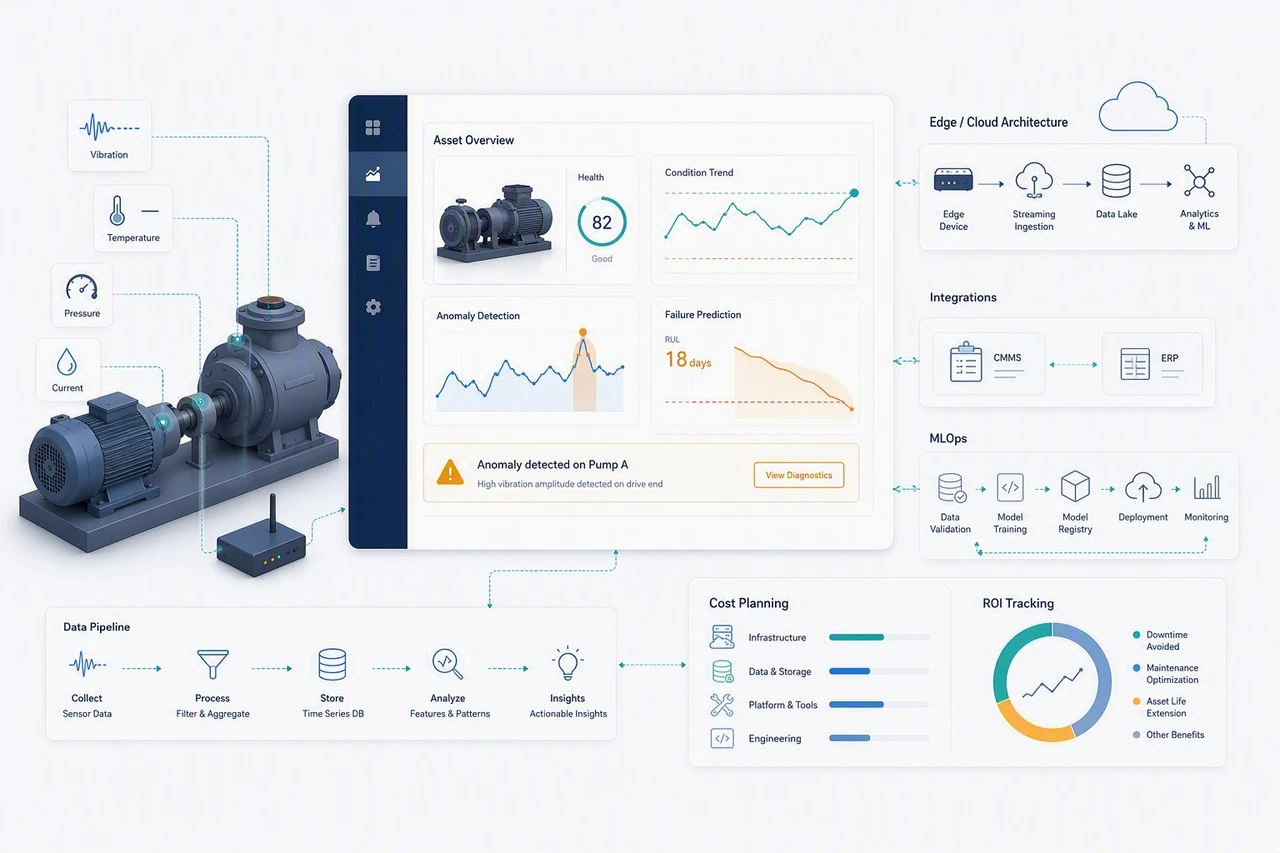
Predictive maintenance software development cost depends on asset complexity, data readiness, sensor availability, integrations, deployment model, AI/ML requirements, and rollout scale. A software-only pilot using existing machine data may cost far less than a multi-site platform that requires real-time condition monitoring, failure prediction, CMMS/ERP integration, edge deployment, and ongoing MLOps.
According to the Scopic Software Development Cost guide (2026), software planning anchors align with three categories. A focused proof of concept using existing data may align with a $10,000-$50,000 simple-software band. A production AI/ML application, often representing the core AI predictive maintenance cost, may align with $75,000-$400,000+, while a multi-site enterprise platform or custom condition monitoring software development may align with $150,000-$1,000,000+. These are broader Scopic software categories applied as planning anchors, not predictive-maintenance market averages, and exclude sensors, hardware, installation, OT networking, or plant disruption.
Key Takeaways
- Data Readiness First: Existing data quality and readiness often impact project success more than model sophistication.
- Integration Reality: Pre-installed sensors reduce pilot hardware scope but do not eliminate software integration work.
- Operational Alert Costs: False alerts carry real operational costs, requiring model tuning to balance sensitivity with plant disruption.
- Production Requirements: Scaling beyond a pilot requires structured maintenance workflow integration and ongoing MLOps.
- Baseline-Driven ROI: Financial returns must be measured against your documented historical downtime and maintenance baselines.
Predictive Maintenance Platform Cost by Rollout Stage
According to the Scopic software development cost guide and AI development cost guide, the overall predictive maintenance platform cost depends heavily on complexity. When planning a predictive maintenance platform, factors such as asset count, signal volume, historical failure data, integration quality, deployment constraints, safety requirements, and vendor model can move costs outside standard budget bands. Furthermore, the AI predictive maintenance cost can scale based on the sophistication of the machine learning models required.
| Rollout Stage | Software Planning Range | Typical Scope | Main Exclusions | Decision Gate |
|---|---|---|---|---|
| Focused Pilot or PoC | $10,000 to $50,000 | Existing data, one asset class, basic dashboard, initial anomaly detection | New sensors, hardware installation, real-time OT integration | Validate data quality and feasibility |
| Single-Site Production Platform | $75,000 to $400,000+ | Live data pipelines, asset models, dashboards, alerts, CMMS integration, model validation | Multi-site governance, global reporting, major hardware rollout | Prove workflow fit and ROI potential |
| Multi-Site or Enterprise Rollout | $150,000 to $1,000,000+ | Multi-site asset templates, ERP integration, edge/cloud architecture, governance, MLOps | Hardware procurement, plant disruption, OT network upgrades unless scoped | Validate scalability and operating model |
These ranges are planning anchors, not fixed quotes. Final predictive maintenance platform cost depends on discovery, data quality, asset count, integration complexity, deployment constraints, security requirements, and long-term support needs.
Sensors, Data Acquisition, and Asset Models
According to the Microsoft Fabric reference architecture, predictive maintenance software costs depend on ingestion. Existing SCADA, PLC, or historian data reduces condition monitoring software development expenses. Conversely, custom signal selection, high sampling frequency, gateways, and timestamp alignment for missing data increase engineering hours. AWS architectures show mapping asset hierarchies, operating context, maintenance history, and failure labels requires custom transformation, raising AI predictive maintenance cost.
| Data Foundation | Lower-Complexity Situation | Higher-Complexity Situation | Why Cost Changes |
|---|---|---|---|
| Connectivity | Existing SCADA, PLC, historian, or sensor data is accessible | New gateways, sensors, or OT network work are required | More hardware coordination, data ingestion, and validation |
| Sampling | Low-frequency or already aggregated data | High-frequency or subsecond signals | More storage, processing, synchronization, and pipeline design |
| Asset Context | Clean asset hierarchy and maintenance records exist | Siloed data, missing labels, inconsistent asset names | More data cleaning, mapping, and manual validation |
| Failure History | Known failure events and maintenance outcomes are available | Few failures, unclear labels, or incomplete work-order history | Harder model training, validation, and ROI measurement |
Data Pipelines, Anomaly Detection, and Failure Prediction
Condition monitoring software development tracks real-time assets, while anomaly detection flags deviations. Supervised failure prediction and remaining-useful-life estimation require complex feature engineering to handle scarce failure examples and class imbalance. Predictive maintenance can help teams move from reactive repairs to more planned maintenance workflows, but results depend on data quality, asset type, sensor reliability, integration depth, and how maintenance teams act on alerts. Custom AI development services support model choice by data readiness, helping teams implement effective predictive analytics maintenance software:
- Rule monitoring: Simple threshold checks.
- Condition monitoring: Real-time health tracking.
- Anomaly detection: Unsupervised outlier flagging.
- Predictive analytics: Supervised failure forecasting.
Dashboards, Alerts, and CMMS/ERP Integration
The cost of custom predictive maintenance software scales with complexity. Advanced condition monitoring software development costs rise when adding alert prioritization, acknowledgements, escalation rules, mobile notifications, maintenance recommendations, and audit history. According to AWS guidance, bidirectional ERP integration enables automated work-order creation.
Monitor Only: Real-time dashboards and asset health views with one-way notifications (Email/Teams).
Connected Maintenance Workflow: Automated work-order creation and maintenance dispatch triggered via APIs to CMMS/ERP (e.g., SAP, ServiceNow).
Closed-Loop Learning: Bidirectional integration returning work outcomes to the model pipeline for continuous refinement.
Edge vs Cloud Deployment, Security, and Reliability
According to NIST SP 800-82 Rev. 3, securing predictive analytics maintenance software requires network segmentation and least privilege. Aligning with NIST SSDF and AWS patterns, hybrid condition monitoring software development uses secure device identity, encryption, audit logging, offline buffering, failover, and safe degradation to protect operational ownership.
| Deployment Model | Cost Profile | Strength | Tradeoff | Best-Fit Context |
|---|---|---|---|---|
| Cloud | Lower device-side complexity, higher data transfer and cloud usage planning | Centralized storage, analytics, model training, and multi-site visibility | Connectivity, bandwidth, latency, and data residency constraints | Multi-site analytics, centralized teams, connected assets with reliable network access |
| Edge | More device-side setup, local compute, and device management | Local processing, offline tolerance, and faster on-site decisions | More hardware, update, monitoring, and support complexity | Remote plants, latency-sensitive processes, limited connectivity, local data requirements |
| Hybrid | Highest architecture and governance complexity | Balances local resilience with centralized analytics | Requires careful security, synchronization, and operational ownership | Critical assets, distributed operations, regulated or high-availability environments |
Pilot Design and the Cost of False Alerts
To manage AI predictive maintenance cost, pilots must target a specific scope, like pump bearing wear, using a 90-day window and CMMS workflow. According to the NIST AI RMF, structured evaluation is vital. False positives cause unnecessary inspections, labor, parts, or process interruption, while false negatives lead to missed failures and lost trust.
| Metric | Baseline | Target | Window | Owner |
|---|---|---|---|---|
| Precision & Recall | Historical | TBD | 90d | Data Lead |
| False Alerts/Asset-Period | Historical | TBD | 90d | Maint. Lead |
| Lead Time & Action Rate | Historical | TBD | 90d | Reliability |
| Operational Outcome | Historical | TBD | 90d | Plant Mgr |
MLOps and Ongoing Predictive Maintenance Software Cost
Deploying a predictive maintenance platform is only the beginning of the software lifecycle. According to the NIST AI Risk Management Framework, continuous monitoring and lifecycle governance are essential to maintain trustworthy performance. The Scopic AI Development Cost guide notes that recurring expenses are necessary to address data drift and performance degradation.
Commonly omitted recurring costs include:
- Data-quality and model-performance monitoring
- Model retraining, validation, and versioning
- Cloud or edge infrastructure, logging, and deployment pipelines
- Cybersecurity updates and integration maintenance
- Sensor-health checks, user support, and feature improvements
Pilot, Single-Site, and Multi-Site Cost Scenarios
To align budgeting with operational scope, organizations can evaluate three deployment scenarios based on Scopic’s established cost frameworks for condition monitoring software development and predictive maintenance software.
| Scenario | Asset and Site Scope | Likely Cost Tier | Main Cost Drivers | Rollout Risk | Evidence Needed to Proceed |
|---|---|---|---|---|---|
| Pilot | Software-only pilot using existing historian or sensor data for predictive analytics maintenance software | Entry-level pilot budget | Ingestion, model setup | Poor data quality | Validated MQTT integration |
| Single-Site | Single-site platform connected to live assets and a CMMS | Mid-range predictive maintenance platform cost | API development, UI/UX | Scope creep | CMMS work-order creation |
| Multi-Site | Multi-site platform, asset-template reuse, local variations, centralized governance, edge/cloud operations | Enterprise-scale AI predictive maintenance cost | Template reuse, MLOps | Data drift | Multi-facility data alignment |
How to Measure Predictive Maintenance ROI
To measure returns, verify baseline quality and causal attribution using customer maintenance, production, finance, and quality records. According to Scopic, annual operating costs require 15% to 20% of initial development.
Formulas:
- Annual quantified value = avoided downtime cost + avoided emergency labor and repair cost + verified maintenance-efficiency gains + verified quality, yield, energy, or asset-life gains – annual operating cost
- ROI = (quantified benefit – total cost) / total cost x 100
- Payback period = total cost / annual quantified value
| Operational Metrics | What It Helps Measure |
|---|---|
| Unplanned downtime hours | Emergency work orders |
| MTBF | MTTR |
| Maintenance labor | False-alert response cost |
| Spare-parts usage | Alert-to-action rate |
Scopic Demonstration: Industrial Asset Software in Practice
Scopic’s IR Mapping project is a relevant adjacent example of industrial software for asset inspection and issue identification. The application helps specialists identify pipeline issues through mapping, 3D navigation, issue review, and reporting workflows.
This should not be presented as a predictive maintenance platform unless the case study explicitly supports that claim. Instead, it shows why industrial software projects often require accurate asset data, clear visualization, workflow-specific interfaces, reporting, and reliable software architecture.
For predictive maintenance projects, similar planning questions apply: what asset data is available, how reliable the inputs are, how teams will act on alerts, which systems need integration, and how the platform will be supported after launch.
How to Measure Predictive Maintenance ROI
Predictive maintenance ROI should be measured against the company’s current maintenance and downtime baseline, not against generic industry averages. Before estimating returns, teams need to document how often critical assets fail, how much downtime costs per hour, how much emergency repair work costs, and how maintenance decisions are currently made.
The first step is to define the baseline. This should include unplanned downtime hours, emergency work orders, repair labor, spare-parts usage, mean time between failures, mean time to repair, quality losses, energy waste, and any production delays tied to equipment issues. Without this baseline, it is difficult to prove whether a predictive maintenance platform created measurable value.
The second step is to measure the cost of acting on alerts. False positives can create unnecessary inspections, labor costs, replacement parts, or production interruptions. False negatives can allow failures to go unnoticed. For this reason, ROI should include both the value of avoided failures and the operational cost of inaccurate or poorly timed alerts.
The third step is to compare the annual quantified value against the full cost of the software. That cost should include development, data pipelines, integrations, dashboards, cloud or edge infrastructure, MLOps, model monitoring, security updates, support, and future enhancements.
Use this formula as a planning framework:
Annual quantified value = avoided downtime cost + avoided emergency labor and repair cost + verified maintenance-efficiency gains + verified quality, yield, energy, or asset-life gains – annual operating cost
ROI = (quantified benefit – total cost) / total cost × 100
Payback period = total cost / annual quantified value
Teams should also track operational metrics after launch to confirm whether the platform is improving maintenance decisions in practice.
| Metric | What It Helps Measure |
| Unplanned downtime hours |
Whether the system helps reduce unexpected production interruptions |
| Emergency work orders |
Whether teams are moving from reactive repairs to planned maintenance |
| MTBF |
Whether assets are operating longer between failures |
| MTTR |
Whether repair workflows are becoming faster or more coordinated |
| Maintenance labor |
Whether technician time is being used more efficiently |
| Spare-parts usage |
Whether parts replacement is becoming more predictable |
| False-alert response cost |
Whether alerts are creating avoidable operational work |
| Alert-to-action rate |
Whether maintenance teams trust and act on the system’s recommendations |
Scopic Demonstration: Industrial Asset Software in Practice
Scopic’s IR Mapping project is a relevant adjacent example of industrial software for asset inspection and issue identification. The application helps specialists identify pipeline issues through mapping, 3D navigation, issue review, and reporting workflows.
This should not be presented as a predictive maintenance platform unless the case study explicitly supports that claim. Instead, it shows why industrial software projects often require accurate asset data, clear visualization, workflow-specific interfaces, reporting, and reliable software architecture.
For predictive maintenance projects, similar planning questions apply. Teams need to understand what asset data is available, how reliable the inputs are, how maintenance or inspection teams will act on the information, which systems need to be integrated, and how the platform will be supported after launch.
This type of planning is especially important for condition monitoring software development and predictive analytics maintenance software because the value of the platform depends on more than model accuracy. The software also needs to fit real operational workflows, support clear decision-making, and give maintenance teams enough context to act on alerts.
Conclusion
Predictive maintenance software development cost depends on data readiness, asset criticality, sensor and integration scope, model complexity, deployment model, false-alert tolerance, and rollout scale. A focused pilot can help validate data quality and workflow fit before a company invests in a single-site production platform or multi-site enterprise rollout.
The strongest estimates come from discovery, not generic price ranges. Teams need to assess available asset data, historical maintenance records, CMMS/ERP integration needs, edge or cloud requirements, security constraints, and how ROI will be measured against current downtime and maintenance baselines.
For companies planning condition monitoring software development or predictive analytics maintenance software, the goal should be to connect technical decisions with operational value. A useful platform must do more than detect anomalies. It must support real maintenance workflows, reduce alert noise, integrate with existing systems, and remain reliable after launch.
If you are evaluating a predictive maintenance pilot or production rollout, Scopic can help assess your asset data, integrations, model options, deployment constraints, and measurable success criteria before development begins. Contact our professionals today.
FAQ
How much does predictive maintenance software cost to develop?
The development cost for custom predictive maintenance software typically spans three tiers depending on project scope. A focused pilot or proof of concept requires a minimal initial outlay, while a single-site production platform increases the investment to a mid-range tier. For a multi-site or enterprise rollout, software costs scale to a substantial enterprise-level budget. The final budget depends on asset complexity, data pipeline requirements, user interface needs, and integration depth with existing systems.
What is included in a predictive maintenance platform cost?
A predictive maintenance platform cost covers several core software engineering components, including secure time-series data pipelines, asset models, and anomaly detection or failure-prediction algorithms. It also covers user interface design for dashboards, alert systems, and role-based access controls. Additionally, the budget includes integration with existing CMMS or ERP systems via APIs, edge or cloud deployment setup, and security configurations. These software development costs are entirely separate from hardware expenses, such as physical sensors and network infrastructure.
How much does an AI predictive maintenance pilot cost?
An AI predictive maintenance pilot typically requires a modest entry-level budget, focusing on a limited scope such as a single critical asset or a small group of similar machines. The AI predictive maintenance cost for this stage covers data ingestion from existing historians, feature engineering, and training initial models for anomaly detection. A pilot helps validate data quality and model feasibility before committing to a full-scale production rollout. It also establishes baseline performance metrics to justify further development investments.
Is condition monitoring software development cheaper than failure-prediction software?
Yes, condition monitoring software development is generally less expensive than building failure-prediction software. Condition monitoring focuses on real-time threshold alerts and rule-based anomaly detection, which require simpler data pipelines and no complex machine learning models. In contrast, failure-prediction software requires sophisticated predictive analytics maintenance software to estimate remaining useful life, which involves historical failure data, complex feature engineering, and continuous model training. Consequently, failure-prediction systems require more development hours, specialized data science expertise, and ongoing MLOps support, which increases the overall project budget.
How do you calculate predictive maintenance ROI?
To calculate the return on investment, you must compare the annual quantified value of the software against its development and operational costs. The quantified value is calculated by subtracting the new cost of downtime, maintenance, and false alerts from your historical baseline costs. You then divide this annual net benefit by the initial software development cost plus annual operating expenses, which typically represent a standard percentage of the initial cost. Because this calculation relies heavily on your specific historical baseline data, a thorough discovery phase is required to establish realistic financial projections.
This guide was written by Scopic Team
Scopic provides quality and informative content, powered by our deep-rooted expertise in software development. Our team of content writers and experts have great knowledge in the latest software technologies, allowing them to break down even the most complex topics in the field. They also know how to tackle topics from a wide range of industries, capture their essence, and deliver valuable content across all digital platforms.



 Message Scopio