
Table of Contents
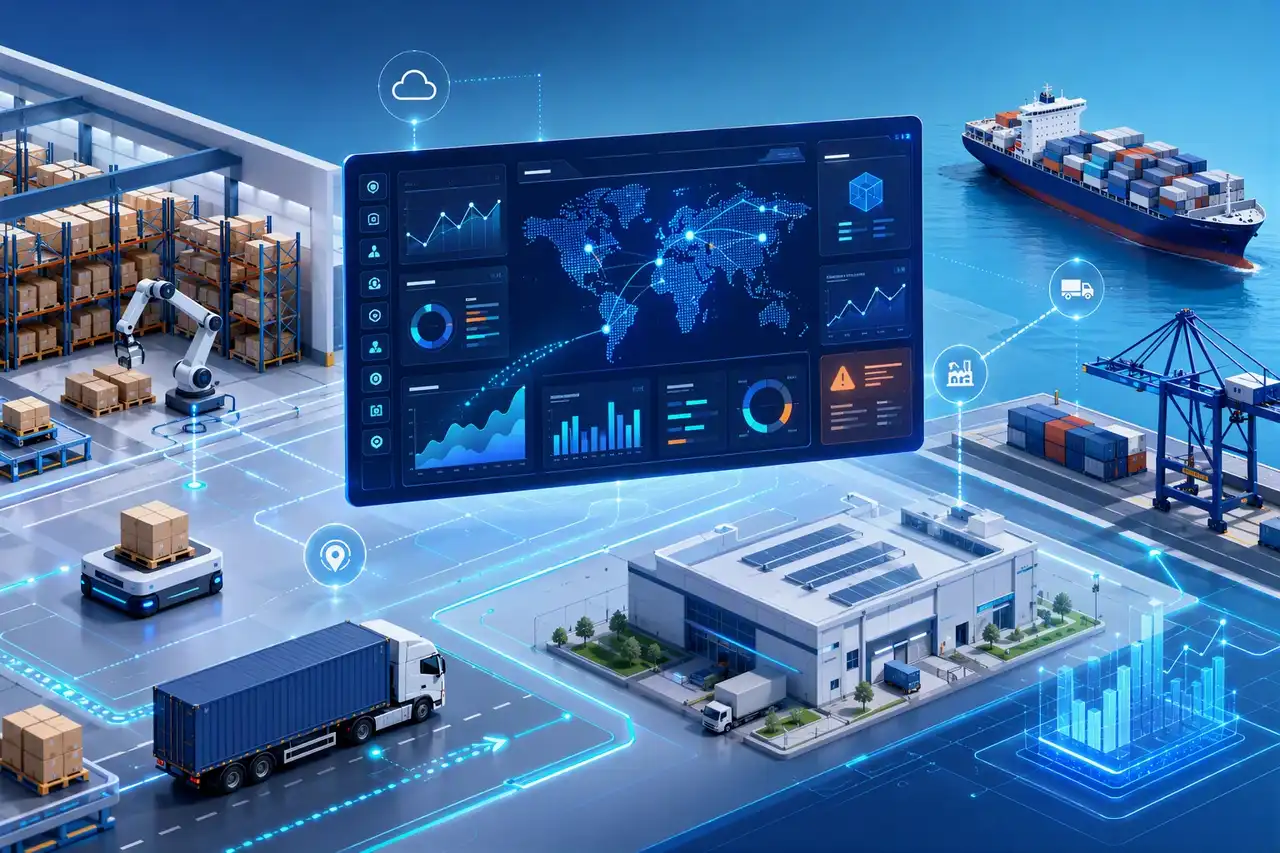
Supply chain management trends in 2026 are increasingly defined by software capabilities, not abstract shifts in management philosophy. Planning teams can use machine learning to sense demand, while operations teams connect shipment, warehouse, supplier, and asset data to improve execution. The value depends on whether those capabilities fit existing processes and produce decisions people can act on.
This list examines ten technology-enabled trends shaping planning, sourcing, logistics, and fulfillment. For readers tracking emerging trends in supply chain management, the focus is practical: the underlying technology, the operational problem it addresses, and the specific system, model, data pipeline, or integration pattern required to make it useful. That distinction matters when leaders compare investments, because a control tower without reliable event data, or an AI forecast without governed demand history, creates another dashboard rather than better decisions.
Use the trends to assess capability gaps across your supply chain, then validate data quality, integration effort, user workflows, and measurable decision outcomes before selecting an implementation path.
Key Takeaways
- Move AI beyond standalone reporting by integrating demand-sensing and forecasting models into planner workflows with confidence ranges, review controls, and managed overrides.
- Treat visibility and traceability as integration outcomes: prioritize API connectivity, event pipelines, and shared identifiers before adding more sensors.
- Use digital twins and scenario models to test inventory, capacity, routing, and network decisions before execution.
- Address supplier risk with structured supplier data, external signals, alerts, and resilience analytics that support sourcing decisions.
- Make clean, connected supply chain data the shared foundation for control towers, planning, simulation, automation, and traceability.
Supply Chain Management Trends at a Glance
Use this table to compare each trend’s enabling technology, required software capability, and primary operational outcome before evaluating the detailed applications behind these broader trends in supply chain management.
| Trend | Core technology and software capability | Primary outcome |
|---|---|---|
| AI demand planning | ML demand sensing and probabilistic forecasting | Better inventory decisions |
| Control towers | API and EDI connectors, event and batch ingestion, data normalization, alerts, and exception workflows | Faster response to disruption |
| Digital twins | Network simulation models and scenario interfaces | Safer capacity and routing tests |
| IoT asset tracking | Sensors, edge gateways, and location pipelines | Near-real-time asset condition, location, and ETA updates |
| Warehouse automation | WMS, WES, and WCS orchestration with robotics and equipment APIs | Faster, more accurate fulfillment |
| Network optimization | Optimization solvers and scenario models | Lower-cost sourcing and routes |
| Supplier risk intelligence | Risk scoring models and supplier data feeds | Earlier mitigation decisions |
| End-to-end traceability | Standards-based event records, shared identifiers, and lot or serial genealogy | Stronger recall and compliance evidence |
| API-first integration | API gateways, webhooks, and EDI adapters | More reliable cross-system and partner data exchange |
| Modern data architecture | Warehouse or lakehouse, streaming pipelines, master data, metadata, data quality, and governance | Consistent planning analytics |
1. AI-Driven Demand Planning and Forecasting
Machine learning forecasting models can combine demand history, promotions, prices, seasonality, product attributes, and selected external signals. They can complement statistical baselines, update forecasts more frequently, and reduce manual intervention in suitable product or market segments. They should not be treated as automatically more accurate: teams need to benchmark them against simpler models, monitor deterioration, and retain explainable exceptions and override controls. Gartner predicts that 70% of large-scale organizations will adopt AI-based supply chain forecasting by 2030.
The operational value comes from embedding predictions into replenishment, inventory, and sales and operations planning workflows. Planners can review exceptions, test promotion assumptions, and approve forecast changes in one process instead of assembling recurring spreadsheets or waiting for a separate analytics report. Models should also capture forecast versioning, confidence ranges, and feedback from planner overrides so the planning cycle improves over time.
AI planning is also moving beyond standalone predictions toward software agents that assemble signals, identify exceptions, and propose actions. Gartner includes agentic AI and collaborative multiagent systems among its top supply chain technologies for 2026, while emphasizing the need for explainability, accountability, and responsible-use guardrails. In planning systems, that means high-impact replenishment, sourcing, or allocation decisions should remain subject to approval thresholds and audit trails. Building these capabilities may require custom AI development when off-the-shelf planning software cannot accommodate proprietary data, constraints, or approval logic.
The required software capability is an AI demand-forecasting model integrated directly into the planning workflow, with governed data inputs, exception management, scenario adjustments, and approved forecasts feeding downstream supply and inventory decisions.
2. Control Towers and Real-Time Supply Chain Visibility
A supply chain control tower is a decision-support layer that combines current and historical information from ERP, transportation, warehouse, order, and supplier systems. Depending on source-system capabilities, it may use real-time events, near-real-time updates, or scheduled batch feeds. Its value comes from identifying and prioritizing operational exceptions—not simply displaying more data.
An effective control tower ingests data through APIs, EDI connections, event streams, and batch pipelines; normalizes entities such as orders, shipments, locations, and inventory; and connects alerts to ownership and response workflows. A delayed shipment alert, for example, should include the affected order, current milestone, expected impact, responsible team, and available action path.
Software capability: an integrated visibility and decision layer with ERP, WMS, TMS, carrier, and supplier connectors; event and batch ingestion; data normalization; role-based views; alerts; and accountable exception workflows.
3. Digital Twins for Supply Chain Simulation
Digital twins represent supply chain networks as virtual models of nodes, lanes, inventory policies, suppliers, and fulfillment constraints. According to IBM, teams can use these models to test changes such as switching suppliers, rerouting shipments, or adding distribution capacity before committing real inventory or capacity.
A useful twin supports controlled what-if scenarios: planners can compare service, cost, inventory, and utilization outcomes under a disruption or policy change. It should also preserve assumptions and scenario versions, so operators can review why a recommendation changed and hand an approved plan to execution. The model is only useful when its network structure and state reflect current conditions, including lead times, orders, stock positions, and available capacity.
Software capability: a simulation model kept in sync with live network data through event or batch integrations, with configurable constraints, scenario comparison, and links to planning and execution workflows.
4. IoT and Edge Data for Real-Time Asset Tracking
IoT sensors attached to trucks, pallets, containers, and warehouse assets can capture location, temperature, vibration, and other condition signals at configured intervals or when relevant events occur. According to IBM’s Edge Computing for IoT, edge computing processes and analyzes IoT data near its collection point, such as inside a vehicle or warehouse, instead of sending every event to a central system first. This shorter path reduces latency and allows edge devices, potentially using machine learning, to identify anomalies and trigger faster exception handling.
For supply chain leaders, the value is operational: a temperature excursion can prompt investigation while goods are still in transit, and a location deviation can update an ETA or escalation workflow before a delivery window is missed. Gateways can forward validated events to cloud services when connectivity is available, supporting a consistent record across transport, custody, and compliance processes. The required software capability is edge-processed sensor data feeding control tower and traceability systems, with device management, event rules, offline buffering, and alerts tied to accountable teams.
5. Warehouse and Logistics Automation
Warehouse automation is expanding from fixed, single-purpose equipment toward connected robotics, automated storage and retrieval systems, and AI-assisted orchestration. Gartner identifies polyfunctional robots and physical AI among its leading supply chain technology trends for 2026. MHI and Deloitte’s 2025 industry report also projected that robotics and automation adoption would reach 83% over the following five years.
The operational gain comes from coordinating hardware with execution software. A warehouse management system (WMS) manages inventory and releases warehouse work, while a warehouse execution system (WES) or warehouse control system (WCS) sequences tasks and coordinates conveyors, AS/RS equipment, and robots. A transportation management system (TMS) plans shipments, carriers, loads, routes, and dispatch. Integrating these systems keeps inventory, fulfillment, and transportation statuses synchronized.
This architecture also lets leaders monitor exceptions, such as equipment delays or incomplete picks, within inventory and transportation workflows. The required software capability is a WMS/TMS integration layer, with WCS and equipment APIs, that orchestrates automated equipment and synchronizes fulfillment data across warehouse and transportation operations.
6. Scenario Modeling and Network Optimization
Scenario modeling combines network data, business constraints, and optimization models to compare alternatives before teams change contracts, inventory policies, facility capacity, or transportation plans. Planners can model supplier loss, port closure, demand spikes, facility constraints, and route changes. IBM notes that supply chain simulations can test decisions such as adding a distribution center or switching suppliers before those changes are made in live operations.
The useful comparison is not a single lowest-cost answer. Planners should review total cost, service levels, capacity, lead times, sourcing rules, and disruption exposure across scenarios, then examine trade-offs by product, lane, facility, and time horizon. A model can also expose when a cheaper route increases dependency on a constrained node or weakens customer coverage.
This capability supports decisions such as facility placement, supplier allocation, safety-stock policy, and contingency routing.
Software capability: an optimization engine that runs multiple network scenarios against real constraints, with configurable assumptions, comparable outputs, and versioned decisions for planner review.
7. Supplier Risk Intelligence
Supplier risk intelligence is moving from periodic manual reviews toward continuous monitoring. Platforms can combine internal performance measures—such as on-time delivery, lead-time variation, defects, capacity, and contract compliance—with external indicators such as financial condition, sanctions, weather, logistics disruption, and geopolitical exposure. Gartner identifies supplier financial-risk assessment, geopolitical-risk capture, automated monitoring, and continuous risk review as relevant supply chain risk-management capabilities.
The World Economic Forum’s 2026 Global Value Chains Outlook describes structural volatility across global trade, making data-driven risk scoring useful for comparing disruption exposure across suppliers, regions, and categories. Scores should be explainable, time-stamped, and linked to evidence such as late deliveries, quality events, sanctions exposure, financial filings, or logistics interruptions. They should also trigger workflows, including alternate-source reviews, purchase-order holds, or supplier remediation plans.
The required software capability is a supplier risk-scoring system integrated with sourcing and procurement data, with configurable indicators, score history, alerts, and action workflows.
8. End-to-End Traceability
End-to-end traceability follows a product or component through its full journey across suppliers, carriers, facilities, and customers. It depends on standardized identifiers and shared event data across trading partners, not just internal warehouse or ERP tracking. According to GS1, EPCIS records real-world events across organizations and locations, capturing what happened, when, where, and why. EPCIS 2.0 can also share object-status data, including temperature and shock conditions, giving downstream teams more context for investigations and recalls.
The required capability is an event-based traceability service—EPCIS-compatible where partner interoperability requires it—that validates identifiers, records custody and process events, and preserves their business context. It should exchange authorized events through partner APIs, support genealogy from component to finished product, and make exceptions searchable across the network.
9. Resilient, API-First Integrations
Supply chains commonly depend on a mixture of APIs, EDI messages, event streams, managed file transfers, and legacy connectors. API-first therefore should not be interpreted as API-only. Point-to-point integrations can be brittle, but APIs can also break consumers when schemas, authentication methods, version policies, or runtime behavior change.
Resilience comes from explicit contracts, compatibility rules, automated contract tests, idempotent processing, retries, dead-letter handling, observability, and governed deprecation schedules. The OpenAPI Specification can document HTTP API operations and their request and response schemas, while EDI and event-stream interfaces require their own versioned schemas and validation controls. Without dependable feeds, control towers, forecasts, and traceability systems can display stale or incomplete information.
These requirements also influence implementation and maintenance budgets. Scopic’s API integration cost guide explains how authentication, data mapping, webhooks, retries, testing, and monitoring affect project scope.
10. Modern Supply Chain Data Architecture
Modern supply chain data architecture is not a simple migration from a traditional warehouse to a data fabric. Warehouses, lakehouses, streaming platforms, master-data systems, and data-fabric patterns solve different problems and often coexist. The appropriate design depends on operational latency, data volume, source ownership, analytics workloads, partner access, and governance requirements.
A warehouse or lakehouse can provide historical analytical storage, while streaming pipelines distribute operational events and master-data services maintain consistent identifiers for products, suppliers, facilities, orders, and shipments. Metadata catalogs, lineage, quality rules, and access controls help teams understand and govern those assets. IBM defines a data fabric as an architectural approach—not a single piece of software—that connects distributed data across on-premises and multicloud environments without requiring every source to be moved into one repository.
The required software capability is a governed data layer that makes trusted supply chain data discoverable and usable across planning, visibility, simulation, traceability, and risk applications. Look for source connectors, master-data management, identity resolution, event processing, metadata, lineage, quality monitoring, access controls, and workload-appropriate query interfaces.
How These Trends Work Together
These trends form a connected operating model, not a collection of separate projects. Modern supply chain data architecture establishes governed, shared context across orders, inventory, shipments, suppliers, and locations. Resilient, API-first integrations keep that context flowing when systems, partners, or data formats change.
That foundation supports control-tower visibility, traceability, and IoT or edge events. Together, these capabilities turn distributed activity into timely, trusted signals while preserving the history needed to investigate exceptions. AI planning can then use those signals to refine forecasts and highlight decisions that need review.
Digital twins, scenario models, and optimization engines form a decision layer above this data foundation. They allow planners to compare alternatives before changing sourcing, inventory, capacity, or transportation plans. Together, the required platform capabilities include governed pipelines, event and integration APIs, shared identifiers, model services, operational workflows, and approval controls. For companies pursuing broader digital manufacturing, this supply chain foundation can connect planning and fulfillment with manufacturing execution and asset-management initiatives.
Conclusion
These supply chain management trends share one underlying requirement: trustworthy data connected to an operational decision and a defined response workflow. AI forecasts, control towers, simulations, automation, traceability, and supplier-risk models provide limited value when data is incomplete, identifiers conflict, integrations fail, or users cannot act on the output.
Rather than purchasing disconnected tools, start with the decision or operational constraint that needs improvement. Define the required signals, data owners, acceptable latency, system integrations, users, approval rules, and measurable outcome. This makes it possible to implement one useful capability first and expand the architecture without creating another isolated platform.
Scopic develops custom manufacturing software for IoT and machine-learning applications, real-time monitoring, stock tracking, workflow optimization, and connected operational systems. If your roadmap includes demand planning, supply chain visibility, automation, or data integration, explore Scopic’s manufacturing software development services or contact our team to discuss the project.
FAQ
What is the biggest trend in supply chain management right now?
There is no universal biggest trend for every supply chain. The broadest shift in 2026 is toward connected, AI-assisted decision systems that combine governed operational data, timely event processing, predictive models, and workflows for responding to exceptions. The priority for a specific organization depends on its main constraint: forecast accuracy, inventory visibility, supplier risk, fulfillment capacity, traceability, or integration reliability.
How is AI used in supply chain management?
AI is used to forecast demand, detect unusual shipment or inventory patterns, estimate supplier disruption exposure, recommend replenishment actions, and prioritize exceptions. Machine learning models can combine historical transactions with promotions, lead times, weather, location, and other relevant signals, while generative AI can help users query data or summarize operational issues. The software should still expose confidence levels, source data, approval controls, and an audit trail. A practical implementation connects model outputs to planning and execution workflows, rather than leaving predictions in a separate reporting interface.
What is a supply chain control tower?
A supply chain control tower is a software layer that brings together events from planning, order management, warehouse, transportation, and supplier systems to show current conditions and unresolved exceptions. It is more useful than a dashboard when each alert includes context, severity, ownership, and an action path. Leaders can use it to monitor delayed orders, inventory imbalances, capacity constraints, or missed milestones across multiple partners. The required capability is an event-driven visibility platform with data normalization, role-based views, configurable alerts, and workflow integration with systems that can resolve the issue.
What is a supply chain digital twin?
A supply chain digital twin is a maintained computational representation of a network, including facilities, suppliers, routes, capacities, policies, lead times, and demand relationships. Planners use it to test changes such as reallocating volume, adjusting safety stock, changing transportation modes, or responding to a port closure without altering live operations. Its usefulness depends on current, governed data and models that represent constraints realistically. The software capability is a scenario engine that can clone a planning state, run simulations, compare service, cost, and risk outcomes, and preserve assumptions for review.
Do these trends apply to small and mid-sized companies, or only large enterprises?
They apply to smaller organizations, but the implementation path should be narrower and tied to a measurable operating problem. A mid-sized distributor might begin with API-connected order and transportation data, exception alerts, or demand forecasting for a small product group before building a broader control tower or digital twin. Cloud services can reduce infrastructure requirements, while modular architecture allows capabilities to expand over time. The key software requirements remain data ownership, integration reliability, user permissions, and workflows that fit existing planning and fulfillment practices.
This guide was written by Scopic Team
Scopic provides quality and informative content, powered by our deep-rooted expertise in software development. Our team of content writers and experts have great knowledge in the latest software technologies, allowing them to break down even the most complex topics in the field. They also know how to tackle topics from a wide range of industries, capture their essence, and deliver valuable content across all digital platforms.



 Message Scopio